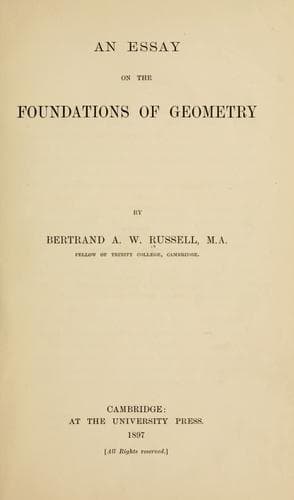
An essay on the foundations of geometry — John Shaqi
An essay on the foundations of geometryRussell, Bertrand
Philosophy
An essay on the foundations of geometry
Russell, Bertrand
Geometry -- Foundations
[7] Klein's first account of elliptic Geometry, as a result of
Cayley's projective theory of distance, appeared in two articles
entitled "Ueber die sogenannte Nicht-Euklidische Geometrie, I,
II," Math. Annalen 4, 6 (1871-2). It was afterwards independently
discovered by Newcomb, in an article entitled "Elementary Theorems
relating to the geometry of a space of three dimensions, and of
uniform positive curvature in the fourth dimension," Crelle's
Journal für die reine und angewandte Mathematik, Vol. 83 (1877). For
an account of the mathematical controversies concerning elliptic
Geometry, see Klein's "Vorlesungen über Nicht-Euklidische Geometrie,"
Göttingen 1893, I. p. 284 ff. A bibliography of the relevant
literature up to the year 1878 was given by Halsted in the American
Journal of Mathematics, Vols. 1, 2.
[8] Veronese (op. cit. p. 638) denies the priority of Gauss in the
invention of a non-Euclidean system, though he admits him to have
been the first to regard the axiom of parallels as indemonstrable.
His grounds for the former assertion seem scarcely adequate: on the
evidence against it, see Klein, Nicht-Euklid, I. pp. 171-174.
[9] V. Briefwechsel mit Schumacher, Bd. II. p. 268.
[10] f. Helmholtz, Wiss. Abh. II. p. 611.
[11] Crelle's Journal, 1837.
[12] Theorie der Parallellinien, Berlin, 1840. Republished, Berlin,
1887. Translated by Halsted, Austin, Texas, U.S.A. 4th edition, 1892.
[13] Frischauf, Absolute Geometrie, nach Johann Bolyai, Leipzig,
1872. Halsted, The Science Absolute of Space, translated from the
Latin, 4th edition, Austin, Texas, U.S.A. 1896.
[14] Both Lobatchewsky and Bolyai, as Veronese remarks, start rather
from the point-pair than from distance. See Frischauf, Absolute
Geometrie, Anhang.
[15] Compare Stallo, Concepts of Modern Physics, p. 248.
[16] Gesammelte Werke, pp. 255-268.
[17] On the history of this word, see Stallo, Concepts of Modern
Physics, p. 258. It was used by Kant, and adapted by Herbart to
almost the same meaning as it bears in Riemann. Herbart, however,
also uses the word _Reihenform_ to express a similar idea. See
Psychologie als Wissenschaft, I. § 100 and II. § 139, where Riemann's
analogy with colours is also suggested.
[18] Compare Erdmann's "Grössenbegriff vom Raum."
[19] Compare Veronese, op. cit. p. 642: "Riemann ist in seiner
Definition des Begriffs Grösse dunkel." See also Veronese's whole
following criticism.
[20] Vorträge und Reden, Vol. II. p. 18.
[21] Cf. Klein, Nicht-Euklid, I. p. 160.
[22] Since we are considering the curvature at a point, we are only
concerned with the first infinitesimal elements of the geodesics that
start from such a point.
[23] Disquisitiones generales circa superficies curvas, Werke, Bd.
IV. SS. 219-258, 1827.
Public-domain text, read in full here on John Shaqi.
Reviews
Reviews
No reviews yet
Be the first to share your thoughts on this work.
Join the Discussion
Join the discussion
Sign in to leave a comment or review.
Sign InorCreate an account