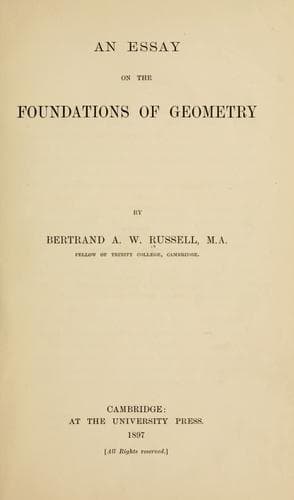
An essay on the foundations of geometryRussell, Bertrand
Philosophy
An essay on the foundations of geometry
Russell, Bertrand
Geometry -- Foundations
These three axioms, it will be seen, are the equivalents of the
three axioms of metrical Geometry[65], expressed without reference
to quantity. We shall find them to be deducible, as before, from
the homogeneity of space, or, more generally still, from the
possibility of experiencing externality. They will therefore appear
as _à priori_, as essential to the existence of any Geometry and to
experience of an external world as such.
=50.= That some logical necessity is involved in these axioms might,
I think, be inferred as probable, from their historical development
alone. For the systems of Metageometry have not, in general, been set
up as more likely to fit facts than the system of Euclid; with the
exception of Zöllner, for example, I know of no one who has regarded
the fourth dimension as required to explain phenomena. As regards the
space-constant again, though a _small_ space-constant is regarded
as empirically possible, it is not usually regarded as probable;
and the finite space-constants, with which Metageometry is equally
conversant, are not usually thought even possible, as explanations
of empirical fact[66]. Thus the motive has been throughout not one
of fact, but one of logic. Does not this give a strong presumption,
that those axioms which are retained, are retained because they are
logically indispensable? If this be so, the axioms common to Euclid
and Metageometry will be _à priori_, while those peculiar to Euclid
will be empirical. After a criticism of some differing theories of
Geometry, I shall proceed, in Chapters III. and IV., to the proof and
consequences of this thesis, which will form the remainder of the
present work.
FOOTNOTES:
[5] V. Mémoires de l'Académie royale des Sciences de l'lnstitut de
France, T. XII. 1833, for a full statement of his results, with
references to former writings.
[6] This bolder method, it appears, had been suggested, nearly a
century earlier, by an Italian, Saccheri. His work, which seems to
have remained completely unknown until Beltrami rediscovered it in
1889, is called "Euclides ab omni naevo vindicatus, etc." Mediolani,
1733. (See Veronese, Grundzüge der Geometrie, German translation,
Leipzig, 1894, p. 636.) His results included spherical as well as
hyperbolic space; but they alarmed him to such an extent that he
devoted the last half of his book to disproving them.
Public-domain text, read in full here on John Shaqi.
Reviews
Reviews
No reviews yet
Be the first to share your thoughts on this work.
Join the Discussion
Join the discussion
Sign in to leave a comment or review.
Sign InorCreate an account