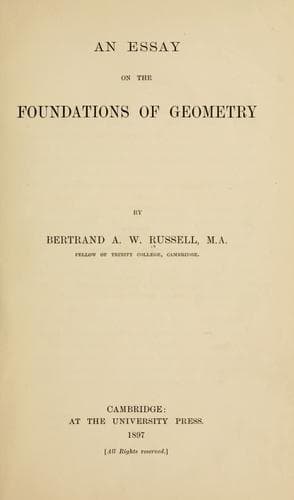
An essay on the foundations of geometry — John Shaqi
An essay on the foundations of geometryRussell, Bertrand
Philosophy
An essay on the foundations of geometry
Russell, Bertrand
Geometry -- Foundations
[47] Elements of Projective Geometry, Second Edition, Oxford, 1893,
Chap. IX.
[48] Chap. III. Section B.
[49] See Nicht-Euklid, I. p. 338 ff.
[50] See his Geometrie der Lage, § 8, Harmonische Gebilde.
[51] The anharmonic ratio of four numbers, _p_, _q_, _r_, _s_, is
defined as
(p - q).(r - s) / (p - r).(q - s).
[52] _I.e._ as transformable into each other by a collineation. See
Chap. III. Sec. A, § 110.
[53] See Chap. III. Sec. A.
[54] It follows from this, that the reduction of metrical to
projective properties, even when, as in hyperbolic Geometry, the
Absolute is real, is only apparent, and has a merely technical
validity.
[55] Sir R. Ball does not regard his non-Euclidean content as a
possible space (_v. op. cit._ p. 151). In this important point I
disagree with his interpretation, holding such a content to be a
space as possible, _à priori_, as Euclid's, and perhaps actually true
within the margin due to errors of observation.
[56] See Nicht-Euklid, I. p. 97 ff. and p. 292 ff.
[57] Newcomb says (_loc. cit._ p. 293): "The system here set forth is
founded on the following three postulates.
"1. I assume that space is triply extended, unbounded, without
properties dependent either on position or direction, and possessing
such planeness in its smallest parts that both the postulates of the
Euclidean Geometry, and our common conceptions of the relations of
the parts of space are true for every indefinitely small region in
space.
"2. I assume that this space is affected with such curvature that a
right line shall always return into itself at the end of a finite and
real distance 2_D_ without losing, in any part of its course, that
symmetry with respect to space on all sides of it which constitutes
the fundamental property of our conception of it.
"3. I assume that if two right lines emanate from the same point,
making the indefinitely small angle _a_ with each other, their
distance apart at the distance _r_ from the point of intersection
will be given by the equation
s = 2aD/π sin rπ/2D.
The right line thus has this property in common with the Euclidean
right line that two such lines intersect only in a single point.
It may be that the number of points in which two such lines can
intersect admit of being determined from the laws of curvature,
but not being able so to determine it, I assume as a postulate the
fundamental property of the Euclidean right line."
It is plain that in the absence of the determination spoken of, the
possibility of elliptic space is not established. It may be possible,
for example, to prove that, in a space where there is a maximum to
distance, there must be an infinite number of straight lines joining
two points of maximum distance. In this event, elliptic space would
become impossible.
[58] For an elucidation of this term, see Klein, Nicht-Euklid, I. p.
99 ff.
Public-domain text, read in full here on John Shaqi.
Reviews
Reviews
No reviews yet
Be the first to share your thoughts on this work.
Join the Discussion
Join the discussion
Sign in to leave a comment or review.
Sign InorCreate an account