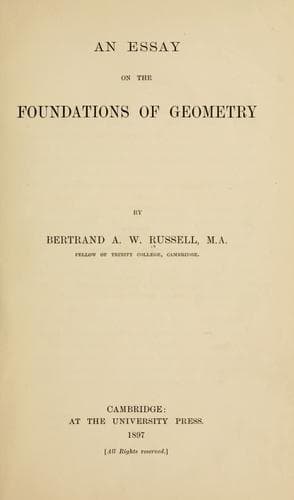
An essay on the foundations of geometryRussell, Bertrand
Philosophy
An essay on the foundations of geometry
Russell, Bertrand
Geometry -- Foundations
[59] Cf. p. 9 of Report: "My own view is that Euclid's twelfth axiom,
in Playfair's form of it, does not need demonstration, but is part
of our notion of space, of the physical space of our experience,
but which is the representation lying at the bottom of all external
experience."
[60] The exception to this axiom, in spherical space, presupposes
metrical Geometry, and does not destroy the validity of the axiom for
projective Geometry. See Chap. III. Sec. B, § 171.
[61] Mathematicians of Lie's school have a habit, at first somewhat
confusing, of speaking of motions of space instead of motions of
bodies, as though space as a whole could move. All that is meant is,
of course, the equivalent motion of the coordinate axes, _i.e._ a
change of axes in the usual elementary sense.
[62] "Ueber die Grundlagen der Geometrie," Leipziger Berichte, 1890.
The problem of these two papers is really metrical, since it is
concerned, not with collineations in general, but with motions. The
problem, however, is dealt with by the projective method, motions
being regarded as collineations which leave the Absolute unchanged.
It seemed impossible, therefore, to discuss Lie's work, until some
account had been given of the projective method.
[63] Lie's premisses, to be accurate, are the following:
Let
x{1} = f(x, y, z, a{1}, a{2}...)
x{2} = φ(x, y, z, a{1}, a{2}...)
x{3} = ψ(x, y, z, a{1}, a{2}...)
give an infinite family of real transformations of space, as to which
we make the following hypotheses:
A. The functions f, φ, ψ, are _analytical_ functions of
x, y, z, a{1}, a{2}....
B. Two points x{1}y{1}z{1}, x{2}y{2}z{2} possess an
invariant, _i.e._
Ω(x{1}, y{1}, z{1}, x{2}, y{2}, z{2}) =
Ω(x{1′}, y{1′}, z{1′}, x{2′}, y{2′}, z{2′})
where x{1′}..., x{2′}..., are the transformed coordinates of
the two points.
C. Free Mobility: _i.e._, any point can be moved into any other
position; when one point is fixed, any other point of general
position can take up ∞^{2} positions; when two points are fixed, any
other of general position can take up ∞^{1} positions; when three, no
motion is possible--these limitations being results of the equations
given by the invariant Ω.
[64] On this point, cf. Klein, Höhere Geometrie, Göttingen, 1893, II.
pp. 225-244, especially pp. 230-1.
[65] Axiom II. of the metrical triad corresponds to Axiom III. of the
projective, and _vice versâ_.
[66] Cf. Helmholtz, Wiss. Abh. Vol. II. p. 640, note: "Die Bearbeiter
der Nicht-Euklidischen Geometrie (haben) deren objective Wahrheit nie
behauptet."
CHAPTER II.
CRITICAL ACCOUNT OF SOME PREVIOUS PHILOSOPHICAL THEORIES OF GEOMETRY.
Public-domain text, read in full here on John Shaqi.
Reviews
Reviews
No reviews yet
Be the first to share your thoughts on this work.
Join the Discussion
Join the discussion
Sign in to leave a comment or review.
Sign InorCreate an account