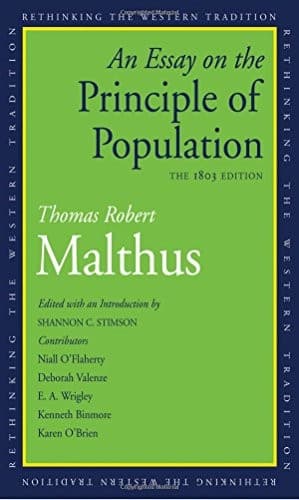
An Essay on the Principle of PopulationMalthus, T. R. (Thomas Robert)
Philosophy
An Essay on the Principle of Population
Malthus, T. R. (Thomas Robert)
Population
The system of equality which Mr Godwin proposes is, without doubt, by
far the most beautiful and engaging of any that has yet appeared. An
amelioration of society to be produced merely by reason and conviction
wears much more the promise of permanence than any change effected and
maintained by force. The unlimited exercise of private judgement is a
doctrine inexpressibly grand and captivating and has a vast superiority
over those systems where every individual is in a manner the slave of
the public. The substitution of benevolence as the master-spring and
moving principle of society, instead of self-love, is a consummation
devoutly to be wished. In short, it is impossible to contemplate the
whole of this fair structure without emotions of delight and
admiration, accompanied with ardent longing for the period of its
accomplishment. But, alas! that moment can never arrive. The whole is
little better than a dream, a beautiful phantom of the imagination.
These 'gorgeous palaces' of happiness and immortality, these 'solemn
temples' of truth and virtue will dissolve, 'like the baseless fabric
of a vision', when we awaken to real life and contemplate the true and
genuine situation of man on earth. Mr Godwin, at the conclusion of the
third chapter of his eighth book, speaking of population, says:
There is a principle in human society, by which population is
perpetually kept down to the level of the means of subsistence. Thus
among the wandering tribes of America and Asia, we never find through
the lapse of ages that population has so increased as to render
necessary the cultivation of the earth.
This principle, which Mr Godwin thus mentions as some mysterious and
occult cause and which he does not attempt to investigate, will be
found to be the grinding law of necessity, misery, and the fear of
misery.
The great error under which Mr Godwin labours throughout his whole work
is the attributing almost all the vices and misery that are seen in
civil society to human institutions. Political regulations and the
established administration of property are with him the fruitful
sources of all evil, the hotbeds of all the crimes that degrade
mankind. Were this really a true state of the case, it would not seem a
hopeless task to remove evil completely from the world, and reason
seems to be the proper and adequate instrument for effecting so great a
purpose. But the truth is, that though human institutions appear to be
the obvious and obtrusive causes of much mischief to mankind, yet in
reality they are light and superficial, they are mere feathers that
float on the surface, in comparison with those deeper seated causes of
impurity that corrupt the springs and render turbid the whole stream of
human life.
Mr Godwin, in his chapter on the benefits attendant on a system of
equality, says:
Public-domain text, read in full here on John Shaqi.
Reviews
Reviews
No reviews yet
Be the first to share your thoughts on this work.
Join the Discussion
Join the discussion
Sign in to leave a comment or review.
Sign InorCreate an account