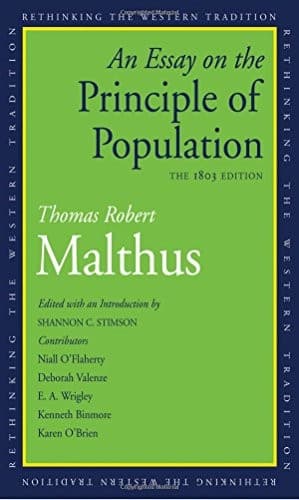
An Essay on the Principle of PopulationMalthus, T. R. (Thomas Robert)
Philosophy
An Essay on the Principle of Population
Malthus, T. R. (Thomas Robert)
Population
Let us suppose all the causes of misery and vice in this island
removed. War and contention cease. Unwholesome trades and manufactories
do not exist. Crowds no longer collect together in great and pestilent
cities for purposes of court intrigue, of commerce, and vicious
gratifications. Simple, healthy, and rational amusements take place of
drinking, gaming, and debauchery. There are no towns sufficiently large
to have any prejudicial effects on the human constitution. The greater
part of the happy inhabitants of this terrestrial paradise live in
hamlets and farmhouses scattered over the face of the country. Every
house is clean, airy, sufficiently roomy, and in a healthy situation.
All men are equal. The labours of luxury are at end. And the necessary
labours of agriculture are shared amicably among all. The number of
persons, and the produce of the island, we suppose to be the same as at
present. The spirit of benevolence, guided by impartial justice, will
divide this produce among all the members of the society according to
their wants. Though it would be impossible that they should all have
animal food every day, yet vegetable food, with meat occasionally,
would satisfy the desires of a frugal people and would be sufficient to
preserve them in health, strength, and spirits.
Mr Godwin considers marriage as a fraud and a monopoly. Let us suppose
the commerce of the sexes established upon principles of the most
perfect freedom. Mr Godwin does not think himself that this freedom
would lead to a promiscuous intercourse, and in this I perfectly agree
with him. The love of variety is a vicious, corrupt, and unnatural
taste and could not prevail in any great degree in a simple and
virtuous state of society. Each man would probably select himself a
partner, to whom he would adhere as long as that adherence continued to
be the choice of both parties. It would be of little consequence,
according to Mr Godwin, how many children a woman had or to whom they
belonged. Provisions and assistance would spontaneously flow from the
quarter in which they abounded, to the quarter that was deficient. (See
Bk VIII, ch. 8; in the third edition, Vol II, p. 512) And every man
would be ready to furnish instruction to the rising generation
according to his capacity.
I cannot conceive a form of society so favourable upon the whole to
population. The irremediableness of marriage, as it is at present
constituted, undoubtedly deters many from entering into that state. An
unshackled intercourse on the contrary would be a most powerful
incitement to early attachments, and as we are supposing no anxiety
about the future support of children to exist, I do not conceive that
there would be one woman in a hundred, of twenty-three, without a
family.
Public-domain text, read in full here on John Shaqi.
Reviews
Reviews
No reviews yet
Be the first to share your thoughts on this work.
Join the Discussion
Join the discussion
Sign in to leave a comment or review.
Sign InorCreate an account