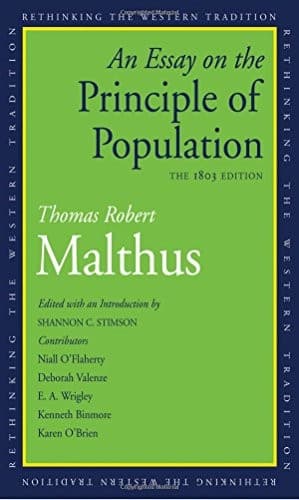
An Essay on the Principle of PopulationMalthus, T. R. (Thomas Robert)
Philosophy
An Essay on the Principle of Population
Malthus, T. R. (Thomas Robert)
Population
It might be urged perhaps by some objectors that, as the fertility of
the land increased, and various accidents occurred, the share of some
men might be much more than sufficient for their support, and that when
the reign of self-love was once established, they would not distribute
their surplus produce without some compensation in return. It would be
observed, in answer, that this was an inconvenience greatly to be
lamented; but that it was an evil which bore no comparison to the black
train of distresses that would inevitably be occasioned by the
insecurity of property; that the quantity of food which one man could
consume was necessarily limited by the narrow capacity of the human
stomach; that it was not certainly probable that he should throw away
the rest; but that even if he exchanged his surplus food for the labour
of others, and made them in some degree dependent on him, this would
still be better than that these others should absolutely starve.
It seems highly probable, therefore, that an administration of
property, not very different from that which prevails in civilized
states at present, would be established, as the best, though
inadequate, remedy for the evils which were pressing on the society.
The next subject that would come under discussion, intimately connected
with the preceding, is the commerce between the sexes. It would be
urged by those who had turned their attention to the true cause of the
difficulties under which the community laboured, that while every man
felt secure that all his children would be well provided for by general
benevolence, the powers of the earth would be absolutely inadequate to
produce food for the population which would inevitably ensue; that even
if the whole attention and labour of the society were directed to this
sole point, and if, by the most perfect security of property, and every
other encouragement that could be thought of, the greatest possible
increase of produce were yearly obtained; yet still, that the increase
of food would by no means keep pace with the much more rapid increase
of population; that some check to population therefore was imperiously
called for; that the most natural and obvious check seemed to be to
make every man provide for his own children; that this would operate in
some respect as a measure and guide in the increase of population, as
it might be expected that no man would bring beings into the world, for
whom he could not find the means of support; that where this
notwithstanding was the case, it seemed necessary, for the example of
others, that the disgrace and inconvenience attending such a conduct
should fall upon the individual, who had thus inconsiderately plunged
himself and innocent children in misery and want.
The institution of marriage, or at least, of some express or implied
obligation on every man to support his own children, seems to be the
natural result of these reasonings in a community under the
difficulties that we have supposed.
Public-domain text, read in full here on John Shaqi.
Reviews
Reviews
No reviews yet
Be the first to share your thoughts on this work.
Elsewhere in the archive
Join the Discussion
Join the discussion
Sign in to leave a comment or review.
Sign InorCreate an account