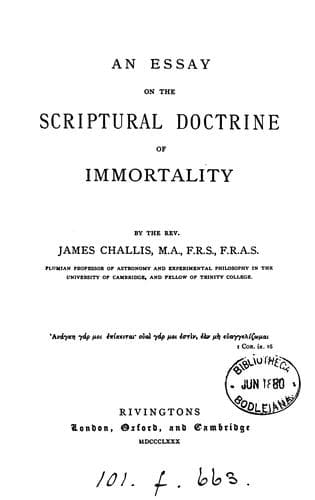
An Essay on the Scriptural Doctrine of ImmortalityChallis, James
Religion
An Essay on the Scriptural Doctrine of Immortality
Challis, James
Immortality
which for that reason alone is not itself subject to death. If we be
guided solely by what _we see with our eyes_, this appears to be the
only allegorical sense that can be attributed to the first clause of
Mark ix. 44.[3] We have next to inquire as to the {90} interpretation
of the other clause, and what is the mutual relation between the two
clauses.
Although the worm which devours dead bodies is not emblematic of
anything that causes pain, the case is quite otherwise with respect to
the emblematic meaning of _fire_. It is evident that fire which is
"unquenchable" is not natural fire, and consequently may be taken to
be, as has already been assumed, the devouring fire of judgment and of
condemnation consequent upon violation of the law of righteousness (see
p. 88). The destruction of the impenitent unrighteous by the operation
of this law (which is their second death), is attended with pain and
woe such as will not have been before, nor will be after. It was
inferred (p. 84) from our Lord's teaching in Matt. xviii. 6, that any
form of _death_ of which the body is susceptible in this world is
rather to be endured than falling under condemnation in the world to
come. In Mark ix. 42-48, we are taught that any form of bodily _pain_,
as that of losing a hand, a foot, or an eye, is to be preferred to
entering with the body whole into the "_geenna_ of fire." This is, in
fact, at once the greatest and the _last_ of human suffering and
tribulation. For it should be noticed that at the end of this very
passage (v. 49) it is said that "every one shall be salted [made
'good,' _v._ 50] with fire," signifying the effect finally produced by
the unquenchable fire. And with this agrees the emblem {91} of the
worm that "dieth not," taken as indicating that the final effect of the
torment of the judgment is to swallow up death, and to bring in, by
establishing the reign of righteousness, life and immortality. The
signification of one emblem must be taken in conjunction with that of
the other.
Public-domain text, read in full here on John Shaqi.
Reviews
Reviews
No reviews yet
Be the first to share your thoughts on this work.
Join the Discussion
Join the discussion
Sign in to leave a comment or review.
Sign InorCreate an account