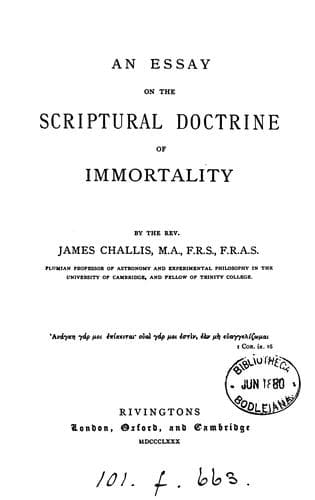
An Essay on the Scriptural Doctrine of ImmortalityChallis, James
Religion
An Essay on the Scriptural Doctrine of Immortality
Challis, James
Immortality
There is still another passage--Mark ix. 42-50--which, on account of
its peculiar significance, it is necessary to discuss with reference to
the Scriptural argument for immortality. It will suffice for
conducting the discussion to cite _vv._ 43 and 44, the literal
translation of which is as follows:--"If thy hand cause thee to offend,
cut it off: it is well for thee to enter into life maimed, rather than
having two hands to go into geenna, into the unquenchable fire, where
their worm dieth not, and the fire is not {88} quenched." The
concluding part of this text is evidently derived from Isaiah lxvi. 24,
where the prophet reveals that the Lord has said respecting the
worshippers, consisting of "all flesh," that shall come before him when
"the new heavens and the new earth" are established, that "they shall
go forth and look upon the carcases of the men that have transgressed
against me: for their worm shall not die, neither shall their fire be
quenched: and they shall be an abhorring unto all flesh." This passage
has so important a bearing on the sense of that quoted above from St.
Mark, that we must by all means endeavour to find out its
interpretation. Respecting Biblical Interpretation, Burnet in one of
his treatises has enunciated two principles, which cannot but be
assented to: first, that besides the portions of Scripture which have a
literal or historical meaning, there are others which must be taken
allegorically; and, secondly, that an allegorical meaning, is to be
admitted when the literal sense involves an absurdity, or contradiction
to the nature of things.[2] The right application of these principles
may be said to constitute a large portion of the science of Scripture.
But in applying them it is often difficult to decide, respecting a
particular passage, whether it is to be {89} taken literally or
allegorically; and again, after deciding that the passage must be
allegorical, there is generally the still greater difficulty of
discovering what the true sense is. In illustration of the second of
the above principles Burnet cites, apart from the context, _vermem
nunquam moriturum_, and admits that these words have an allegorical
signification. This plainly follows from the single consideration that
the worm (_skolex_) here spoken of is literally that which is seen to
feed on dead bodies, and to say of it that it does not die is
contradictory to experience. When, however, the same author goes on to
give as the allegorical sense nothing more definite than "_extremam
miseriam_," it may well be asked, By what kind of induction has this
conclusion been reached? The feeble worm which feeds on mortal remains
presents to our sight nothing capable of causing pain or misery.
Rather it may, I think, be asserted that Scripture here adverts to this
natural fact for the purpose of indicating by a distinct and visible
emblem that there is a living principle which destroys mortality, and
Public-domain text, read in full here on John Shaqi.
Reviews
Reviews
No reviews yet
Be the first to share your thoughts on this work.
Join the Discussion
Join the discussion
Sign in to leave a comment or review.
Sign InorCreate an account