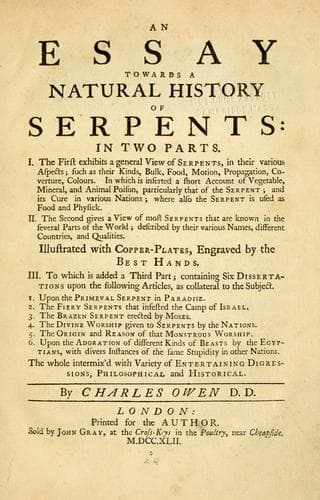
An essay towards a natural history of serpentsOwen, Charles
History
An essay towards a natural history of serpents
Owen, Charles
Serpent worship -- Early works to 1800; Serpents -- Early works to 1800; Serpents -- Religious aspects -- Early works to 1800
For this Method of curing venemous Wounds by Suction, _Avicenna_, an old
_Arabian_ Philosopher and physician, is quoted; who says, that those who
suck out the Poison are in no danger, so their Teeth be sound and
perfect, and their Mouths be free from all Ulcers. At _Rome_ was an
Order of Servants whose Office was to suck venemous Wounds, which they
did with Safety and Applause[59].
Footnote 59:
Sr. _Redi_, p. 185.
“Many _acid Substances_ taken into the Stomach, are, by its
action turned into _Alcalious_; so there is no question but
these _saline Spicula_ are, partly by the muscular Motion of the
Fibres, partly by the salival Juice, all broken and dissolved;
or if any escape into the Intestines, the Balsam of the Bile
will be an Antidote for them. _p. 14._”
Creatures reputed venemous, are indeed no Poisons when swallowed, tho’
the Venom may prove so when put into Wounds.
The Venom that falls upon the Skin, is not so mischievous as that which
enters into the Stomach, or is communicated by a Wound. “Yea, the Venom
of a Viper, in itself, is not mortal to a robust and strong Body; and
tho’ very unhappy and mischievous Accidents attend it, as Convulsions,
Vomitings, _&c._” yet in eight or ten Days at most, these are over; tho’
the Patient may be very ill, yet he recovers, while the Poison having
run thro’ divers Parts of the Body, at last always throws itself into
the _Scrotum_, and is discharg’d by a great Quantity of Urine: This
Evacuation being the ordinary and most certain Crisis of the
Disease[60].
Footnote 60:
Philosoph. Transactions abridged by _Lowthorp_, Vol. II. p. 814.
_Noxia Serpentum est admisso sanguine partis._ Lucani Pharsalia.
Amstelod. Edit. p. 266.
The Water—which amphibious Serpents frequent, receives no venemous
Tincture from them. When _Marcus Cato_ commanded in _Africa_ (the
Element of poisonous Animals) he had in his Army a Number of those
Natives called _Psylli_ and _Marci_, the supposed Aversion of Serpents,
and who suck’d the Wounds of those hurt by them. It is said, these
_Psyllians_ inchanted Serpents, who fled at the sight of them, as if
their Bodies exhaled some _corpuscular Effluviums_ that were most
offensive to Serpents, and put them into such pain that made them run.
To these, the General added another Set of Persons, famous for curing
the wounded by other Methods; and all little enough, Serpents being the
Lords of the Country through which they were to pass[61].
Footnote 61:
_Auli Gellii Noctes Atticæ_, lib. 16. c. 11. p. 161. _Herodot._ lib.
4. _Plutarch in Cato._
Public-domain text, read in full here on John Shaqi.
Reviews
Reviews
No reviews yet
Be the first to share your thoughts on this work.
Join the Discussion
Join the discussion
Sign in to leave a comment or review.
Sign InorCreate an account