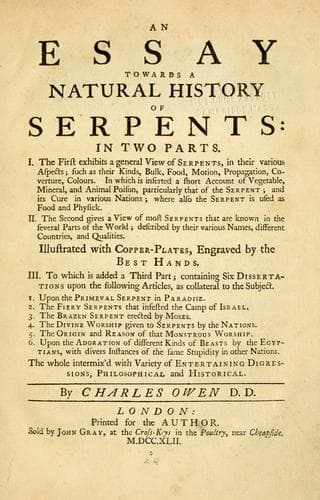
An essay towards a natural history of serpentsOwen, Charles
History
An essay towards a natural history of serpents
Owen, Charles
Serpent worship -- Early works to 1800; Serpents -- Early works to 1800; Serpents -- Religious aspects -- Early works to 1800
The Author of the Description of _Cato_’s marching the Remains of
_Pompey_’s Army through the _Lybian Deserts_, observes, how the Army
being almost choak’d with Thirst, and coming to a Brook full of
Serpents, durst not drink for fear of being poisoned, till convinced by
their Superiors, that their being in the Water, did by no means infect
it: Upon which they refreshed themselves with Water from the Serpentine
River[62].
Footnote 62:
_Redi_, 178. Lucan_’s_ Pharsal.—_Pocula morte carent_—lib. 9.
Add to this, the Example of Queen _Cleopatra_, who, to prevent her being
carried to _Rome_ in Triumph, ’tis said, poisoned herself, by holding a
Serpent to her own Breast. _Galen_ mentioning this Story, relates from
Authors, that she killed herself, by pouring the Poison of an Asp into a
Wound made in her Arm by her own Teeth; as if under Conviction, that the
Poison would not effectually answer the End, without touching the Blood.
_Ibid._ Of which more in the _Second Part_ of this Discourse.
III. _In Serpents is an inexhaustible Store of Poison._ If they
discharge all their Artillery to-day, their Arsenal will be full
to-morrow. ’Tis true, by a speedy repeated Emission of Poison at one
time, the Viper loses its force, probably by a Diminution in Quantity;
but is recruited in a Short space. Thus, one Viper cannot poison six
Creatures, one immediately after another; the Truth of which is
confirmed by uncontestable Facts.——An Experiment was made by Dr.
_Areskine_, when he was at _Paris_.—Having got a large female Viper, he
made it bite six Pigeons, one immediately after another. The first and
second that were bit, died within half an Hour; one a little before the
other; the third lived about two Hours; the fourth seem’d to be very
sick for a while, but recover’d; the fifth and sixth that were bitten,
were no more hurt than if prick’d with a Pin. _Ibid._
The learned _Italian_, Seignior _Redi_, says, that having, at the
Entrance of Winter, a Scorpion sent him to _Rome_ from _Tunis_ in
_Africa_, he irritated it to sting Pigeons and Pullets, without any bad
Effects; but upon the approach of warm Weather, after eight Months
fasting it was provoked to sting two Pigeons successively, which soon
died; but the third and fourth received no hurt from its Wound. The
Author of the _Natural History of Carolina_, speaking of the
_Rattle-Snakes_, says, they can’t renew their Poison as oft as they
will; for he had seen a Person bit by one of them, who never rightly
recovered, and very hardly escaped with Life; and another Person
immediately after being bit by the same Snake, received no more Hurt
than if bit by a Rat. _p._ 129.[63]
Footnote 63:
New Collection of Voyages, printed A. D. 1711.
_N. B._ Poison in different Countries, is more or less dangerous
according as it is exalted and heighten’d by various Degrees of
Heat; for by Increase of Heat, that venemous Quality is
increased.
OBJECTION.
Public-domain text, read in full here on John Shaqi.
Reviews
Reviews
No reviews yet
Be the first to share your thoughts on this work.
Join the Discussion
Join the discussion
Sign in to leave a comment or review.
Sign InorCreate an account