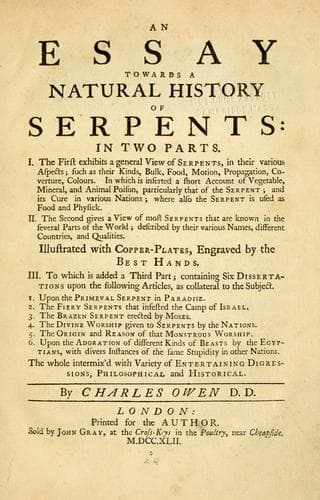
An essay towards a natural history of serpentsOwen, Charles
History
An essay towards a natural history of serpents
Owen, Charles
Serpent worship -- Early works to 1800; Serpents -- Early works to 1800; Serpents -- Religious aspects -- Early works to 1800
_TAKE two dry Walnut-kernels, as many Figs, of Rue twenty Leaves, stamp
all these together into one Mass, with a Grain of Salt._——Under this
Receipt was writ——_Whoever eats this Confection in the Morning fasting,
no Poison shall hurt him that Day_[78]. In _America_, where Lizards are
very good, they eat them, and so large, that one Lizard is enough to
satisfy four Men. ’Tis very probable that they were eaten in _Arabia_
and _Judea_, since _Moses_ ranks them among the unclean Creatures[79].
Footnote 78:
_Pliny_’s Natural Hist. Tom. ii. B. 23.
Footnote 79:
_Calmet in verbum——Hieronym. contra Jovinian._ lib. ii.
Though the Flesh of venemous Creatures be nutrimental, and eaten with a
good Relish, in many Places, yet it must be allow’d our old
Historiographers in some Things hyperbolize upon the Subject. Thus
_Avicenna_, the great _Arabian_ Doctor, and others, speak of a young
Maid, who was fed with the Flesh of poisonous Creatures, from her tender
Age; by which her Breath became venemous to those who stood by her. And
thus _Porus_, a certain _Indian_ King, is said to use Poison every Day,
that he might kill others. It is a known History, adds he, of a young
Woman, fed with Poison, with which the _Persian_ Kings destroy’d whom
they pleas’d.
Add to this another traditional Opinion, _viz._ that some particular
Persons have an evil Eye, which affects Children and Cattle; yea, that
some have this unhappy Faculty, tho’ at the same Time void of any ill
Design. This has been an old Tradition, as appears from that of the
Poet[80].
Footnote 80:
_Nescio quis teneros oculus mihi fascinat agnos._ See _Martin_ on the
Western Islands, _p._ 122, 123.
On the Mountains of _Ceylon_ in the _East-Indies_, are Serpents of such
vast Size, that they swallow young Cattle: Their Flesh is very delicate,
and has a most pleasing Taste; therefore is very much eaten.
This Island of _Ceylon_ is one of the most charming Situation on the
Earth, the Key and Glory of the _Indies_; the Air so temperate, that,
properly speaking, they feel neither Heat nor Cold; the Vales and Hills
are always covered with Flowers, the Fields cover’d with Fruits of all
Sorts; and in the Woods are Serpents call’d _Lizards_, full three Hands
long, whose Flesh is excellent Meat[81].
Footnote 81:
_Ribeyro_’s History of _Ceylon_, presented to the King of _Portugal_,
1685, translated out of _Portuguese_ into _French_, printed at
_Trevoux_, 1701.
In the second Part is a more ample Description of _Ceylon_.
The _Iguana_ Serpent is amphibious, lays numerous Eggs, grateful to the
Taste, is very good Nourishment, preferable to _Spanish_ Rabbits; and in
the City of _Mexico_ these Serpents are brought to the Markets,
especially in the quadragesimal Days.
A _Spanish_ Historian says, the _Iguanas_ are shap’d like the
_Alligators_, very ugly, as big as Lap-dogs, of several Colours; the
_Spaniards_ observe, that their Flesh tastes like the Pheasants, and
feed upon it with pleasure[82].
Public-domain text, read in full here on John Shaqi.
Reviews
Reviews
No reviews yet
Be the first to share your thoughts on this work.
Join the Discussion
Join the discussion
Sign in to leave a comment or review.
Sign InorCreate an account