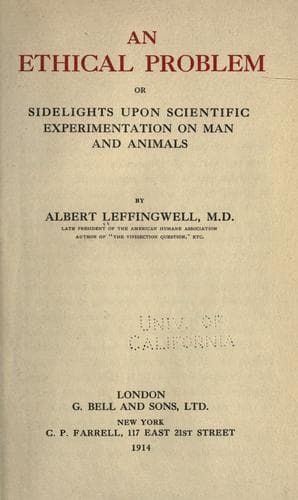
An ethical problem; or, Sidelights upon scientific experimentation on man and animalsLeffingwell, Albert
Philosophy
An ethical problem; or, Sidelights upon scientific experimentation on man and animals
Leffingwell, Albert
Medicine, Experimental; Vivisection
"`This is all excellently said; but we must correct a few errors.
Magendie, alas! performed experiments in public, and sadly too often
at the Colle`ge de France. I remember once, among other instances,
the case of a poor dog, the roots of whose spinal nerves he was about
to expose. Twice did the dog, all bloody and mutilated, escape from
his implacable knife, and twice did I see him put his forepaws around
Magendie's neck and lick his face! I confess--laugh, Messieurs les
Vivisecteurs, if you please--that I could not bear the sight.... It is
true that Dr. P. H. Be'rard, Professor of Physiology, never performed
a single vivisection in his lectures, which were brilliant, elegant,
and animated. but Be'rard was an example of a singular psychological
phenomenon. Toward the close of his life, so painful to him was the
sight of blood and the exhibition of pain, that he gave up the
practice of surgery, and would never allow his students to witness a
vivisection. But Be'rard was attacked by cerebral haemorrhage, and
the whole tone of his character was thereby afterward changed. The
benevolent man became aggressive; the tolerant man, irritable.... He
became an experimenter, and passed whole days in practising
vivisections, TAKING PLEASURE IN THE CRIES, THE BLOOD, AND THE
TORTURES OF THE POOR ANIMALS.'"
The following week the Journal again refers to the subject, the
"ATROCITIES OF VIVISECTION." It is a noteworthy phrase, proceeding
from a medical journal, and should not be forgotten. Concerning the
truth of the charges, the absolute heartlessness exhibited, there can
be no possible doubt, for the evidence is cumulative. Has the phrase
"atrocities of vivisection" appeared in the editorial columns of any
medical journal during the past twenty years, unless in the way of
ridicule or contempt? It may be doubted.
"The atrocities of vivisection continue to occupy the attention of the
Paris papers. The Opinion Nationale says: `The poor brutes' cries of
pain sadden the wards of the clinic, rendering the sojourn there
insupportable both to patients and nurses. Only imagine that, when a
dog has not been killed at one sitting, and that enough life remains
in him to experiment upon him in the following one, they put him back
in the kennel, all throbbing and palpitating! There the unhappy
creatures, already torn by the scalpel, howl until the next day, in
tones rendered hoarse and faint by another operation intended to
deprive them of voice.'"
Again, only three weeks later, in its issue of September 19, 1863, the
British Medical Journal presents in an editorial an account of the
debate on Vivisection in the French Academy of Medicine. It is of
interest, not only as an indication of English opinion at that day,
but also as evidence of what was being done by vivisectors over
fifteen years after the discovery of chloroform.
Public-domain text, read in full here on John Shaqi.
Reviews
Reviews
No reviews yet
Be the first to share your thoughts on this work.
Elsewhere in the archive
Join the Discussion
Join the discussion
Sign in to leave a comment or review.
Sign InorCreate an account