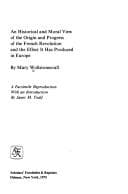
An historical and moral view of the origin and progress of the French Revolution; and the effect it has produced in EuropeWollstonecraft, Mary
Philosophy
An historical and moral view of the origin and progress of the French Revolution; and the effect it has produced in Europe
Wollstonecraft, Mary
France -- History -- Revolution, 1789-1799 -- Causes
Alarmed by the prospect of this junction, one of the members of the
chamber, which almost arrogated to itself the prerogative of
legislation, that of the nobles, proposed an address to the king,
beseeching him to dissolve the states-general; whilst the cause of the
people was there vigorously supported by a minority, feeble as to
numbers, but powerful in argument, animated by the popularity, which
their bold declaration could not fail to produce during the reign of
enthusiasm.
This was a moment pregnant with great events. The court still trusted to
subterfuge, and, holding the representatives of the people in
superlative contempt, affected in some degree to yield to the prayer of
the nation; though signifying, that the king was the only fountain of
justice, and that he would grant every thing which his faithful subjects
could reasonably demand. A trick as palpable as the design was flagrant;
for at the instant they were pretending to see some reason in their
requisitions, they were guarding against their obtaining the only thing
that could secure their rights, an equal representation; holding for
this purpose mischievous councils, composed of characters most obnoxious
in the eyes of the people. In these meetings it was resolved, to amuse
the commons, until the army could be assembled; and then, in case of
obstinacy, they would draw on themselves the consequence. Accordingly
the 20th of june, the day on which the majority of the clergy was to
join the commons, the herald proclaimed a _séance royale_; and a
detachment of guards surrounded the hall of the national assembly, to
take care (such was the shallow pretext) that it should be properly
prepared for the reception of the king. The deputies came to the door at
the usual hour; but only the president (Baillie) and the secretaries
were permitted to enter to take away their papers; and they saw, that
the benches were already removed, and that all the entrances were
guarded by a great number of soldiers.
Courage is seldom relaxed by persecution; and the firm and spirited
proceedings of the assembly on this day, gave the decided blow to the
stratagems of the court. During the first tumult of surprise, it is
true, some of the deputies talked of going immediately to Marly, to
invite the king to come among them, and in a truly paternal manner to
unite his power with their’s to promote the public good; and thus by an
energetic appeal to his heart and understanding, to convince him that
they spoke the language of truth and reason. But others, more
experienced in ministerial wiles, calmly advised to adjourn the sittings
to the neighbouring tennis-court. For they knew, that the hearts of
courtiers are fortified with icy prejudices; and that, though a moment
of sympathy, a flow of life-blood, may thaw them at the instant, it is
only to render them more hard, when the glow of genial heat is passed.
Public-domain text, read in full here on John Shaqi.
Reviews
Reviews
No reviews yet
Be the first to share your thoughts on this work.
Join the Discussion
Join the discussion
Sign in to leave a comment or review.
Sign InorCreate an account