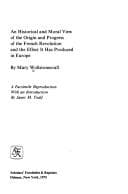
An historical and moral view of the origin and progress of the French Revolution; and the effect it has produced in EuropeWollstonecraft, Mary
Philosophy
An historical and moral view of the origin and progress of the French Revolution; and the effect it has produced in Europe
Wollstonecraft, Mary
France -- History -- Revolution, 1789-1799 -- Causes
From this moment we may consider the nation and court at open war. The
court had at their command the whole military force of the empire,
amounting, at least, to 200,000 men. The people, on the contrary, had
only their bare arms, invigorated, it is true, by the new-born love of
freedom, to oppose to the various weapons of tyranny. But the army,
partaking of the common misery, were not deaf to the complaints or
arguments of their fellow citizens: and they were particularly led to
consider them with complacency, because a just apprehension, or prudent
foresight, had induced many of the popular assemblies, to insert a
clause in their instructions, recommending, that the pay of the soldiers
should be augmented. Thus recognized as fellow citizens, this class of
men, whom it had been the policy of the despots of Europe to keep at a
distance from the other inhabitants, making them a distinct class, to
oppress and corrupt the rest, began to feel an interest in the common
cause. But the court, who either could not, or would not, combine these
important facts, rashly precipitated themselves into the very quicksand,
into which they were vainly endeavouring to drive the commons.
As Necker had not attended in his place, at the _séance royale_, it gave
colour to the rumour, which had for some time prevailed, that he
purposed to retire from the ministry: so that, when the king returned,
he was followed by an immense crowd, who could not conceal their
discontent. Under the influence also of the same fear, a number of the
deputies hastened to Necker, to entreat him not to resign. And the
consternation increasing, the queen, who has ever been the first to
desert her own plans, when there appeared a shadow of personal danger,
sent for him; and, the better to cover the project of the cabinet,
prevailed on him not to quit his post. The object of the cabinet he
either had not the penetration to discover; or he had not sufficient
magnanimity to resign a place, that gratified equally his pride and his
avarice. This measure tended to tranquillize the minds of the people,
though it was undermining their cause; for trusting to the integrity of
this minister, who promised, ‘to live or die with them,’ they did not
perceive, that he wanted the energy of soul necessary to enable him to
act up to the principles he professed. However, the cause of liberty, as
circumstances have proved, did not depend on the talents of one or two
men.—It was the fiat of the nation; and the machinations of the tyrants
of Europe have not yet been able to overturn it; though false patriots
have led them, in their ardour for reform, to the commission of actions
the most cruel and unjust. Every thing was effected by natural causes;
and we shall find, is we take a cursory view of the progress of
knowledge, that it’s advance towards simple principles is invariably in
a ratio, which must speedily change the tangled system of european
politics.
Public-domain text, read in full here on John Shaqi.
Reviews
Reviews
No reviews yet
Be the first to share your thoughts on this work.
Join the Discussion
Join the discussion
Sign in to leave a comment or review.
Sign InorCreate an account