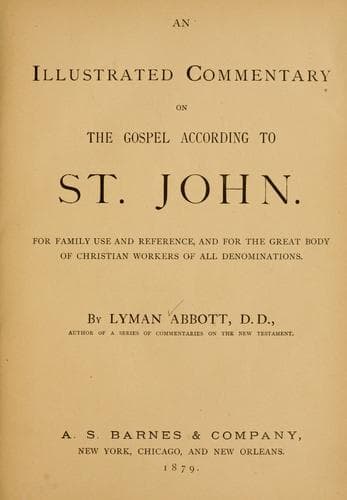
An illustrated commentary on the Gospel according to St. John — John Shaqi
An illustrated commentary on the Gospel according to St. JohnAbbott, Lyman
Religion
An illustrated commentary on the Gospel according to St. John
Abbott, Lyman
Bible. John -- Commentaries
=1. In the beginning.= John begins the Gospel where Moses began the
Law. The employment of and the reference to the language of the
first verse of the first chapter of Genesis is unmistakable. In that
beginning in which God created the heavens and the earth was the Word,
and the Word was with God and was God and was the One through whom
the act of creation was consummated. So in Prov., chap. 8, Wisdom
personified is represented as with God in the creation and from the
beginning (see especially verses 23-29). For parallel passages
teaching the pre-existence of Christ, see John 8:58; 17:5; Phil. 2:5,
6; 1 John 1:1. In Rev. 3:14 he is described as “the beginning of the
creation of God,” but this does not necessarily imply that he was a
created Being. See notes there.--=Was the Word.= There are several
Greek words meaning _word_; (1 and 2) ῥῆμα and ἔπος, word in the
grammatical sense, _i. e._, that which is spoken; (3) μῦθος, word in
the rhetorical sense, that which is delivered by words, the subject
expressed; (4) ὄνομα, word in a technical sense, strictly a _name_,
and only because words are names or appellations; (5) λόγος, word in
the philosophical sense, the outward form by which the inward thought
is expressed. The latter term is employed here. As the thoughts or
experiences of the soul are completely hidden from us till they are
uttered, so God is the Unknown and the Unknowable, save as he utters
himself, discloses his nature to us, which he does chiefly if not
solely through him who is for that reason called the Word, _i. e._,
the utterance of God. The metaphor which underlies this phraseology
is in part interpreted by the saying of Wordsworth that language is
the incarnation of ideas. (2) In the Old Testament we have a partial
employment of the same symbolism. In Moses’ account of the creation,
God is represented as calling the various powers of nature into
being by a _word_. “God said Light be! Light was!” (Gen. 1:3, see
also 6, 9, 11, etc.) In the later Hebrew poetry this symbol is
made more prominent in the distinct declaration that “by the word of
the Lord were the heavens made.” (Ps. 33:6; comp. 107:20; Isaiah
55:10, 11; see also Heb. 11:3.) The same symbol, in a slightly
different form, reappears in Prov., chap. 8, which is connected
with that employed here by the language of certain of the apocryphal
books, _e. g._, “I (Wisdom) came out of the mouth of the Most High
and covered the earth as a cloud” (Ecclesiasticus 24:3). “She
(Wisdom) is the breath of the power of God” (Wisdom of Solomon
1:25). (3) The same symbolism was employed as we have seen (Prel. Note
above) in the mystical philosophy of Alexandria and of later
Gnosticism, with which John was familiar, and of which, Ephesus,
his city, was a centre, to represent an eon or emanation for the
deity. That the Word here does not mean the Bible or the Gospel is
evident both from the connection, since it cannot be said that the
Bible became flesh (ver.
Public-domain text, read in full here on John Shaqi.
Reviews
Reviews
No reviews yet
Be the first to share your thoughts on this work.
Join the Discussion
Join the discussion
Sign in to leave a comment or review.
Sign InorCreate an account