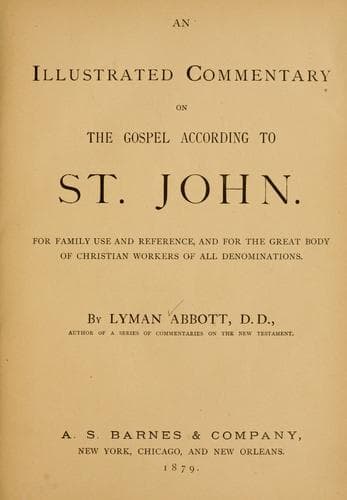
An illustrated commentary on the Gospel according to St. JohnAbbott, Lyman
Religion
An illustrated commentary on the Gospel according to St. John
Abbott, Lyman
Bible. John -- Commentaries
14), and also from John’s usage, who never
employs the phrase Word of God to designate the Bible, but usually
the term Scriptures or writings (John 2:22; 5:39; 7:38, 42; 19:24,
28, 36, 37, etc.). Moreover he does employ this phraseology elsewhere
to designate Jesus Christ (1 John 1:1; Rev. 19:13). It cannot mean
_the Speaking One_ nor _the Promised One_. Though both these meanings
have been attributed to it, it is not grammatically capable of either
interpretation. There is classical authority for rendering it _Reason_
or _Order_, and this meaning it still retains in words ending with
_ology_, such as _ge-ology_ (ge-logos), the order, _i. e._, science of
the earth; _path-ology_ (pathos-logos), the order, _i. e._, science of
disease. But it is never used with this signification by John, and is
never but once so used in the N. T. (1 Peter 3:15), if even there the
translation is strictly accurate, which is doubtful. Seeking, then, to
understand John as he would have been understood by his contemporaries,
I think it clear that he declares, not that Reason or Wisdom was in
the beginning with God, nor Speech, nor the Promised Messiah, but _the
Word_, _i. e._, _the One by and through whom he was chiefly to be
manifested to the world_, as one soul is to another by utterance.--=And
the Word was with God and the Word was God.= Grammatically the last
clause of the sentence may be read, _and God was the Word_. But the
obvious connection calls for the rendering of our English version, and
it is the rendering adopted by the best scholars. There is a difference
in the language of the first and last clause of this sentence in the
original which is significant, but difficult, if not impossible, to
render in the English. In the first clause, “_the Word was with God_,”
the article accompanies the word God; in the second clause, “_the
Word was God_,” it is wanting. We should measurably reflect the
meaning by reading the passage, “the Word was with God and the Word was
divine;” or “the Word was with the Father and the Word was God.”
2 The same was in the beginning with God.
Public-domain text, read in full here on John Shaqi.
Reviews
Reviews
No reviews yet
Be the first to share your thoughts on this work.
Join the Discussion
Join the discussion
Sign in to leave a comment or review.
Sign InorCreate an account