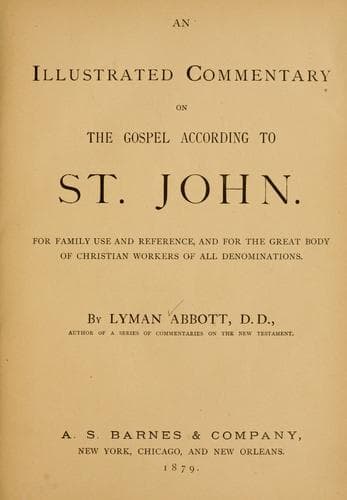
An illustrated commentary on the Gospel according to St. JohnAbbott, Lyman
Religion
An illustrated commentary on the Gospel according to St. John
Abbott, Lyman
Bible. John -- Commentaries
=3. All things were made by him.= To interpret this language “All
things” as meaning simply the moral creation, is to distort plain
language in order to conform it to preconceived ideas, a fault in
exegesis of which no school of theology is entirely innocent. The
reference to Genesis, ch. 1, is unmistakable. The declaration is
parallel to and interpreted by such passages as Col. 1:16; 1 Cor. 8:6;
Heb. 1:2. The Greek student will observe, however, and the English
student should know, that the language here implies that the Word
was the _instrument_ by which God created the “all things,” not the
_original source of creative power_. There are two Greek prepositions
translated in English “_by_,” one (ἐκ) signifying the source or origin
from which anything proceeds, or the power by which it is produced;
the other (διά) signifying the means or instrument through which it is
produced. One indicates the original, the other the proximate cause.
The preposition here used is the latter, and the exact meaning of the
sentence will be imparted by the rendering All things were made _by
means of him_ or _through him_. With this interpretation corresponds
the general teaching of the New Testament, which represents Christ,
both in his earthly life and in his heavenly administration, as always
the executor of his Father’s will. This is in some sense especially
prominent in John’s Gospel (see for example John 5:22, 23, 27; 6:37,
44, 57; 8:28, 42; 10:29; 14:10; 17:18, 24); but it is equally clearly
taught elsewhere (Luke 2:49; 1 Cor. 15:27, 28; Phil. 2:9; Col. 1:19;
comp. Mark 10:40, note and references there).--=And without him was
not anything made that was made.= Simply an emphatic and exhaustive
reiteration, such as is not infrequent in fervid writing. For analogous
rhetorical repetition in John see verse 20; 1 John 2:4, 27. Some
manuscripts and some few scholars put a period at the close of the
first clause of the sentence, and connect the last clause with the
following verse, so that the passage reads: _And without him was not
anything made. And what originated in him was life._ But while this
reading is grammatically possible, it is generally repudiated by the
best scholars, who accept the punctuation and rendering of our English
version as correct.
4 In him[28] was life; and the life was the light[29] of
men.
[28] ch. 5:26; 1 John 5:11.
[29] ch. 8:12.
Public-domain text, read in full here on John Shaqi.
Reviews
Reviews
No reviews yet
Be the first to share your thoughts on this work.
Join the Discussion
Join the discussion
Sign in to leave a comment or review.
Sign InorCreate an account