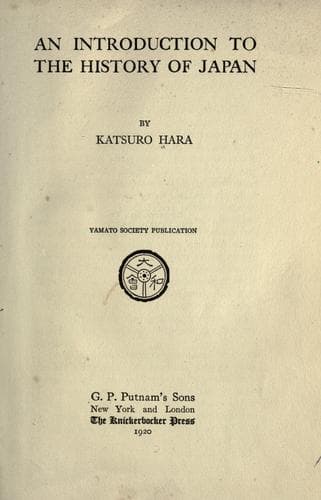
An Introduction to the History of JapanHara, Katsuro
History
An Introduction to the History of Japan
Hara, Katsuro
Japan -- History
Shortly after the Empress Jingu's incursion into Korea the literary
culture of the peninsular states rose suddenly to a higher standard than
that of our country, and enabled them to send into Japan men versed in
writing and reading Chinese characters. At the same time their
immigration was encouraged by the Japanese emperors, and some of the
literati were enlisted into the imperial service. As Japan had at that
time a quasi-caste system, everybody pursuing the profession which he
had inherited from his forefathers, and people belonging to the same
profession forming a group by themselves, several groups were thus
formed, which made reading and writing their exclusive profession.
Almost all the scribes appointed in the reign of the Emperor Richu must
have belonged to one of the families in those groups. As a matter of
course members of the imperial family and those belonging to the
aristocracy began in process of time to be initiated in the elements of
Chinese literature; but still, writing, as a business, continued to be
entrusted to the members of the groups of the penman's craft, and they,
too, rejoiced in monopolising posts and professions which could not
dispense with writing, as secretaries, councillors, notaries, and
ambassadors to foreign countries, and the like. Naturally chroniclers
and historians were to be found solely among them, and there remains
little doubt that far the greater part of the historical manuscripts
consulted by the compilers of the _Nihongi_ were written by those
professional scribes.
It is not much to be wondered at that the art of writing was entrusted
to certain groups of people, while the dominant class in general
remained illiterate. What is most strange is that such a condition could
continue for a very long time in our country, the learned groups, who
had, in their hands, the key of public and private business, being
subjected to the rule of the illiterate. Could it not be explained by
supposing that the ruling class of ancient Japan, though destitute of
book education, yet was endowed with natural abilities, which were more
than enough to cope with the literary culture of that time? If
otherwise, then their prestige should have been easily shaken by the
class of literati within a short interval. It is to be regretted that we
have very few sources to prove positively the ability and attainments
peculiar to the Japanese of that time, but this long continuance of the
illiteracy of the ruling class may serve as a negative proof, that at
least the ruling class was a gifted people, more gifted than was to be
surmised from their illiteracy.
Public-domain text, read in full here on John Shaqi.
Reviews
Reviews
No reviews yet
Be the first to share your thoughts on this work.
Join the Discussion
Join the discussion
Sign in to leave a comment or review.
Sign InorCreate an account