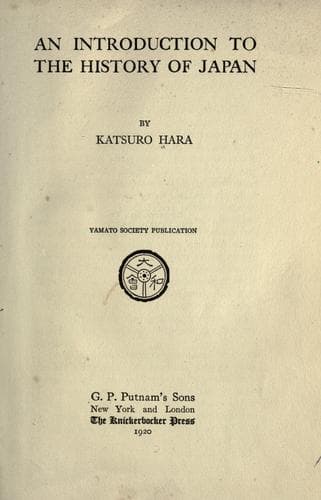
An Introduction to the History of JapanHara, Katsuro
History
An Introduction to the History of Japan
Hara, Katsuro
Japan -- History
Turning to the southwestern part of Japan, it cannot be said that the
whole island of Kyushu was already at the disposal of the Emperor of
that time. In the region which roughly corresponds with the province of
Higo, a tribe called the Kumaso defied the imperial power, and continued
to do so to an age later than the period of which I have just spoken. It
was perhaps not earlier than the middle of the fourth century that their
resistance was finally broken. South of the Kumaso, there lived another
tribe called the Haito in the district afterwards known as the province
of Satsuma. Some of the tribesmen were wont to serve as warriors in the
army of the Emperor from very early times, especially in the imperial
bodyguard. Still the imperial sway could not easily be extended to their
home. The last insurrection of the Haito tribe is recorded to have
happened at the end of the seventh century. That these southern tribes
were subdued more easily than the Ainu on the north, may be attributed
to the fact that their numbers were comparatively small, and that they
might have been more akin in blood to the important element of the
Japanese race than the Ainu were.
CHAPTER IV
GROWTH OF THE IMPERIAL POWER.
GRADUAL CENTRALISATION
It is a privilege of historians to look back. By looking back I do not
mean judging the past from the standpoint of the present. Though it is
quite obvious that past things should be valued first by the standards
of the age contemporaneous with the things to be valued, it would be a
great mistake, if we supposed that the duty of historians was fulfilled
when they could depict the past as it was seen by its contemporaries.
Historians are by no means bound to adhere to the opinions of the
ancients in judging of what happened in the past. How a past thing was
viewed and valued by its contemporary is in itself an important
historical fact, which must be subjected to the criticism of historians.
Not only to have a clear idea of the views held by the people of a
certain period as regards contemporaneous events, a task which is not
hopelessly difficult though not very easy, but also to know why such and
such views happened to be held by those people at that time, is a duty
far more important and difficult to discharge. Historians ought,
besides, to make clear the absolute value of such views and the effects
of them on the age in question as well as on the period that followed.
However necessary it may be to be acquainted with the thoughts and
beliefs of former generations, it is not indeed incumbent upon us to
believe blindly what was believed in the past and to think on the same
lines as was thought by the ancients. Who would not laugh at our folly,
for example, if we should consider the whale of old times to have been a
kind of fish, simply because the ancients did not know it to be a
species of mammalia, though by such a supposition we might perhaps be
Public-domain text, read in full here on John Shaqi.
Reviews
Reviews
No reviews yet
Be the first to share your thoughts on this work.
Elsewhere in the archive
Join the Discussion
Join the discussion
Sign in to leave a comment or review.
Sign InorCreate an account