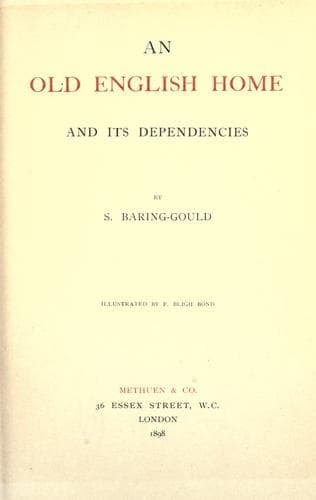
An Old English Home and Its DependenciesBaring-Gould, S. (Sabine)
History
An Old English Home and Its Dependencies
Baring-Gould, S. (Sabine)
England -- Social life and customs
He went to Crooke's cottage to question him. The man was out. He was
horseman to one of the farmers, so Pike pursued him to the farm and
found him ploughing. He asked him if he had seen--picked up anything.
No--Crooke had not observed anything. Indeed, as he remarked, the night
was too dark, and the blackness under the trees was too complete for
him to have seen anything that had been dropped. Crooke seemed somewhat
nettled at being questioned. Of course, had he noticed anything
belonging to the miller fallen out of his trap, or out of his pockets,
he would have handed it to the owner.
Pike was not satisfied. He was convinced that no one had been over the
by-road that morning before he examined it, as it led only to the mill
and to the farm where Crooke worked.
What had become of the money? Had anyone retained it?
Not long afterwards, to the astonishment of the miller and some of
the farmers, Crooke bought a little property, a cottage and a couple
of fields. There was no doubt that he had borrowed some of the money
requisite; he said he had saved the rest. Was that possible? From that
moment a strong and ineradicable conviction formed in Pike's mind that
he had been robbed by Richard Crooke.
With envy and rage he watched the husbandman move into his little
tenement, and begin to till his field. Pike considered that this
tenement was his own by rights. Crooke had bought it with the miller's
money taken from him on the night when he was upset. Crooke had taken
advantage of his being a little fresh, and a little confused by the
fall, to purloin the bag containing twenty-five pounds seventeen
shillings and sixpence.
From this time all joy, all cheeriness was gone from the life of the
miller; his heart turned bitter as gall, and all his bitterness was
directed against Richard Crooke. He brooded over his wrong. He did not
venture openly to accuse the man he suspected, but he dropped hints
which prejudiced opinion against Crooke. But everyone knew that this
Richard had been a careful man, saving his money.
Pike watched the corn grow on Crooke's field; he wished a blight might
fall upon it. But it throve, the ears were heavy, it was harvested in
splendid condition, and stacked in the corner of the field.
Then, one night the corn rick was on fire. This was the work of an
incendiary. It must have been done wilfully, and by someone who bore
Crooke a grudge. Richard had not insured, and the loss to him was a
very serious matter. It might have been ruin had not a "brief" been got
up and some pounds subscribed to relieve him.
No one could say who had done the deed. Yet nobody doubted who the
incendiary had been. Nothing could be proved against anyone.
Public-domain text, read in full here on John Shaqi.
Reviews
Reviews
No reviews yet
Be the first to share your thoughts on this work.
Elsewhere in the archive
Join the Discussion
Join the discussion
Sign in to leave a comment or review.
Sign InorCreate an account