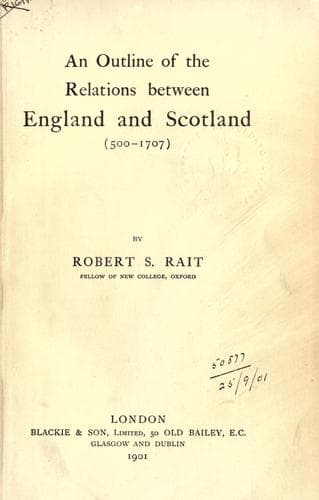
An Outline of the Relations between England and Scotland (500-1707)Rait, Robert S. (Robert Sangster)
History
An Outline of the Relations between England and Scotland (500-1707)
Rait, Robert S. (Robert Sangster)
England -- Foreign relations -- Scotland; Scotland -- Foreign relations -- England
As in the first war the turning-point had proved to be the death of
Edward I in the summer of 1307, so now, exactly thirty years later, came
another decisive event. In the autumn of 1337, Edward III first styled
himself King of France, and the diversion of his energies from the Scots
to their French allies rendered possible the final overthrow of Balliol
and the Scottish traitors. The circumstances are, however, parallel only
to the extent that an intervention of fortune rendered possible the
victory of Scottish freedom. In 1337 there was no great leader: the hour
had come, but not the man. For the next four years, castle after castle
fell into Scottish hands; many of the tales are romantic enough, but
they do not lead to a Bannockburn. The only incident of any significance
is the defence of the castle of Dunbar. The lord of Dunbar was the Earl
of March, whose record throughout the troubles had been far from
consistent, but who was now a supporter of King David, largely through
the influence of his wife, famous as "Black Agnes", a daughter of the
great Randolph, Earl of Moray. From January to June, 1338, Black Agnes
held Dunbar against English assaults by sea and land. Many romantic
incidents have been related of these long months of siege: the stories
of the Countess's use of a dust-cloth to repair the damage done by the
English siege-machines to the battlements, and of her prophecy, made
when the Earl of Salisbury brought a "sow" or shed fitted to protect
soldiers in the manner of the Roman _testudo_,
"Beware, Montagow,
For farrow shall thy sow",
and fulfilled by dropping a huge stone on the machine and thus
scattering its occupants, "the litter of English pigs"--these, and her
"love-shafts", which, as Salisbury said, "pierce to the heart", are
among the most wonderful of historical fairy tales. In the end the
English had to raise the siege:
"Came I early, came I late,
I found Agnes at the gate",
they sang as the explanation of their failure.
Public-domain text, read in full here on John Shaqi.
Reviews
Reviews
No reviews yet
Be the first to share your thoughts on this work.
Elsewhere in the archive
Join the Discussion
Join the discussion
Sign in to leave a comment or review.
Sign InorCreate an account