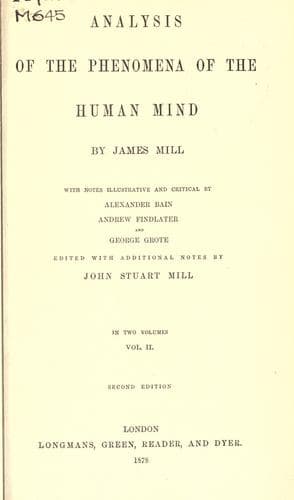
Analysis of the Phenomena of the Human MindMill, James
PhilosophyPhilosophy
Analysis of the Phenomena of the Human Mind
Mill, James
Psychology
"Hæc in genere sors esse solet humana, ut quid in quovis genere
recte aut cogitari aut effici possit sentiant prius quam
perspiciant. Laborem autem haud ita levem illum veriti, qui in eo
impendendus erat ut, ideas operatione analytica penitus evolventes,
quid tandem velint, aut quænam res agatur, sibi ipsis rationem
sufficientem reddant, confusis, aut saltem haud satia explicatis
rationibus, ratiocinia, et scientiarum adeo systemata superstruere
solent communiter, eoque confidentius, quo ejus quam tractant
scientiæ fundamentum solidum magis ignorant."--_Schmidt-Phiseldek_,
_Philos. Criticæ Expositio Systematica_, t. i. p. 561.
"Pour systematiser une science, c'est-à-dire, pour ramener une suite
de phénomènes à leur principe, à un phénomène élémentaire qui
engendre successivement tous les autres, il faut saisir leurs
rapports, le rapport de génération qui les lie; et pour cela, il est
clair qu'il faut commencer par examiner ces différens phénomènes
séparément."--_Cousin_, _Fragm. Philos._, p. 8.
THE sensations which we have through the medium of the senses exist
only by the presence of the object, and cease upon its absence;
nothing being here meant by the presence of the object, but that
position of it with respect to the organ, which is the antecedent of
the sensation; or by its absence, but any other position.
It is a known part of our constitution, that when our sensations
cease, by the absence of their objects, something remains. After I
have seen the sun, and {52} by shutting my eyes see him no longer, I
can still think of him. I have still a feeling, the consequence of
the sensation, which, though I can distinguish it from the
sensation, and treat it as not the sensation, but something
different from the sensation, is yet more like the sensation, than
anything else can be; so like, that I call it a copy, an image, of
the sensation; sometimes, a representation, or trace, of the
sensation.
Another name, by which we denote this trace, this copy, of the
sensation, which remains after the sensation ceases, is IDEA. This
is a very convenient name, and it is that by which the copies of the
sensation thus described will be commonly denominated in the present
work. The word IDEA, in this sense, will express no theory
whatsoever; nothing but the bare fact, which is indisputable. We
have two classes of feelings; one, that which exists when the object
of sense is present; another, that which exists after the object of
sense has ceased to be present. The one class of feelings I call
SENSATIONS; the other class of feelings I call IDEAS.
It is an inconvenience, that the word IDEA is used with great
latitude of meaning, both in ordinary, and in philosophical
discourse; and it will not be always expedient that I should avoid
using it in senses different from that which I have now assigned. I
trust, however, I shall in no case leave it doubtful, in what sense
it is to be understood.
Public-domain text, read in full here on John Shaqi.
Reviews
Reviews
No reviews yet
Be the first to share your thoughts on this work.
Elsewhere in the archive
Join the Discussion
Join the discussion
Sign in to leave a comment or review.
Sign InorCreate an account