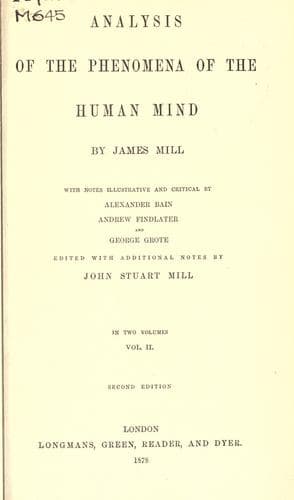
Analysis of the Phenomena of the Human MindMill, James
PhilosophyPhilosophy
Analysis of the Phenomena of the Human Mind
Mill, James
Psychology
[Bain's footnote 18: Discrimination and Retentiveness (the having of
Ideas as the produce of Sensations) are different functions,
although mutually involved, and, in all likelihood, developed in
proportionate degrees in the same organ. We begin by discriminating
changes of impression; this process is necessary in order to our
having even a sensation; the more delicate the discriminating power,
the greater the number of our primary sensations. He that can
discriminate twenty shades of yellow has twenty sensations of
yellow; the two statements express the same fact. These various
sensations being often repeated, acquire at last an ideal
persistence; they can be maintained as ideas, without the originals.
The function or power of the Intellect whereby they are thus
rendered self-subsisting as ideas, is not the same function as
discrimination; we call it Memory, Retentiveness, Adhesiveness,
Association, and so on. What may be affirmed about it, on the
evidence of induction, is, that where discrimination is good, memory
or retentiveness is also good. The discriminative eye for colour is
accompanied with a good memory for colour; the musical ear is both
discriminative and retentive.--_B._]
5. Since we distinguish smells, as well as tastes, {57} we have the
same proof of the number and distinctness of the ideas of this class
of sensations. There is none of the numerous smells to which we have
been accustomed, which we do not immediately recognise. But for that
recognition the idea of the past sensation must be conjoined with
the present sensation.
6. Of that class of sensations, which I have called sensations of
disorganization, we have also ideas. We are capable of having the
thought of them when the sensation is gone; and that thought is the
idea. A spark from the candle flew upon my hand: I had the sensation
of burning. I at this moment think of that sensation; that is, I
have the idea of that sensation; and I can think of it, as different
from ten thousand other painful sensations: that is, I have ideas of
as many other sensations of this class.
Public-domain text, read in full here on John Shaqi.
Reviews
Reviews
No reviews yet
Be the first to share your thoughts on this work.
Elsewhere in the archive
Join the Discussion
Join the discussion
Sign in to leave a comment or review.
Sign InorCreate an account