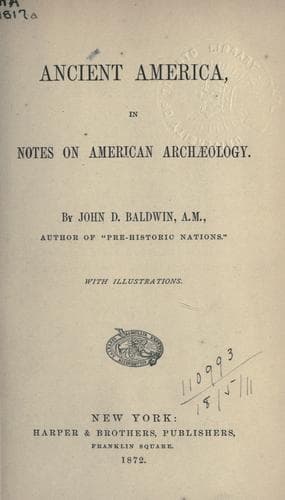
Ancient America, in Notes on American ArchaeologyBaldwin, John D. (John Denison)
History
Ancient America, in Notes on American Archaeology
Baldwin, John D. (John Denison)
America -- Antiquities; America -- Discovery and exploration -- Pre-Columbian; Indians -- Antiquities
In 1520, three hundred and fifty years ago, the forest which so largely
covers Yucatan, Guatemala, and Chiapa was growing as it grows now; yes,
four hundred and fifty years ago, for it was there a century previous to
this date, when, the Maya kingdom being broken up, one of its princes
fled into this forest with a portion of his people, the Itzas, and
settled at Lake Peten. It was the same then as now. How many additional
centuries it had existed no one can tell. If its age could be told, it
would still be necessary to consider that the ruins hidden in it are
much older than the forest, and that the period of civilization they
represent closed long before it was established.
In the ages previous to the beginning of this immense forest, the region
it covers was the seat of a civilization which grew up to a high degree
of development, flourished a long time, and finally declined, until its
cities were deserted, and its cultivated fields left to the wild
influences of nature. It may be safely assumed that both the
forest-covered ruins and the forest itself are far older than the Aztec
period; but who can tell how much older? Copan, first discovered and
described three hundred years ago, was then as strange to the natives
dwelling near it as the old Chaldean ruins are to the Arabs who wander
over the wasted plains of Lower Mesopotamia. Native tradition had
forgotten its history and become silent in regard to it. How long had
ruined Copan been in this condition? No one can tell. Manifestly it was
forgotten, left buried in the forest without recollection of its
history, long before Montezuma’s people, the Aztecs, rose to power; and
it is easily understood that this old city had an important history
previous to that unknown time in the past when war, revolution, or some
other agency of destruction put an end to its career and left it to
become what it is now.
Moreover, these old ruins, in all cases, show us only the cities last
occupied in the periods to which they belong. Doubtless others still
older preceded them; and, besides, it can be seen that some of the
ruined cities which can now be traced were several times renewed by
reconstructions. We must consider, also, that building magnificent
cities is not the first work of an original civilization. The
development was necessarily gradual. Its first period was more or less
rude. The art of building and ornamenting such edifices arose slowly.
Many ages must have been required to develop such admirable skill in
masonry and ornamentation. Therefore the period between the beginning of
this mysterious development of civilized life and the first builders who
used cut stone laid in mortar and cement, and covered their work with
beautifully sculptured ornaments and inscriptions, must have been very
long.
Public-domain text, read in full here on John Shaqi.
Reviews
Reviews
No reviews yet
Be the first to share your thoughts on this work.
Elsewhere in the archive
Join the Discussion
Join the discussion
Sign in to leave a comment or review.
Sign InorCreate an account