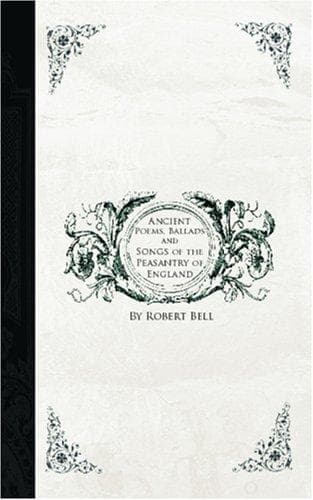
Ancient Poems, Ballads, and Songs of the Peasantry of England
General
Ancient Poems, Ballads, and Songs of the Peasantry of England
Ballads, English -- England -- Texts; Songs, English -- England -- Texts
‘There is a flower in my father’s garden,
They call it marygold;
The fool that will not when he may,
He shall not when he wold.’
Said the shepherd’s son, as he doft his shoon,
‘My feet they shall run bare,
And if ever I meet another maid,
I rede that maid beware.’
THE BEAUTIFUL LADY OF KENT;
OR, THE SEAMAN OF DOVER.
[WE have met with two copies of this genuine English ballad; the older
one is without printer’s name, but from the appearance of the type and
the paper, it must have been published about the middle of the last
century. It is certainly not one of the original impressions, for the
other copy, though of recent date, has evidently been taken from some
still older and better edition. In the modern broadside the ballad is in
four parts, whereas, in our older one, there is no such expressed
division, but a word at the commencement of each part is printed in
capital letters.]
PART I.
A SEAMAN of Dover, whose excellent parts,
For wisdom and learning, had conquered the hearts
Of many young damsels, of beauty so bright,
Of him this new ditty in brief I shall write;
And show of his turnings, and windings of fate,
His passions and sorrows, so many and great:
And how he was blessèd with true love at last,
When all the rough storms of his troubles were past.
Now, to be brief, I shall tell you the truth:
A beautiful lady, whose name it was Ruth,
A squire’s young daughter, near Sandwich, in Kent,
Proves all his heart’s treasure, his joy and content.
Unknown to their parents in private they meet,
Where many love lessons they’d often repeat,
With kisses, and many embraces likewise,
She granted him love, and thus gainèd the prize.
She said, ‘I consent to be thy sweet bride,
Whatever becomes of my fortune,’ she cried.
‘The frowns of my father I never will fear,
But freely will go through the world with my dear.’
A jewel he gave her, in token of love,
And vowed, by the sacred powers above,
To wed the next morning; but they were betrayed,
And all by the means of a treacherous maid.
She told her parents that they were agreed:
With that they fell into a passion with speed,
And said, ere a seaman their daughter should have,
They rather would follow her corpse to the grave.
The lady was straight to her chamber confined,
Here long she continued in sorrow of mind,
And so did her love, for the loss of his dear,—
No sorrow was ever so sharp and severe.
When long he had mourned for his love and delight,
Close under the window he came in the night,
And sung forth this ditty:—‘My dearest, farewell!
Behold, in this nation no longer I dwell.
‘I am going from hence to the kingdom of Spain,
Because I am willing that you should obtain
Your freedom once more; for my heart it will break
If longer thou liest confined for my sake.’
Public-domain text, read in full here on John Shaqi.
Reviews
Reviews
No reviews yet
Be the first to share your thoughts on this work.
Elsewhere in the archive
Join the Discussion
Join the discussion
Sign in to leave a comment or review.
Sign InorCreate an account