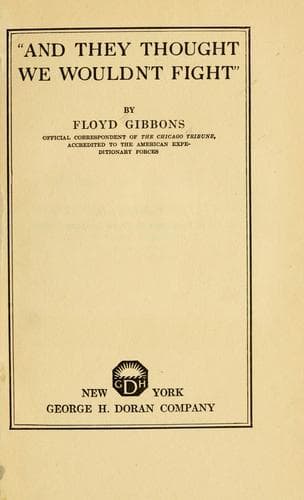
"And they thought we wouldn't fight"Gibbons, Floyd Phillips
History
"And they thought we wouldn't fight"
Gibbons, Floyd Phillips
World War, 1914-1918 -- Campaigns -- Western Front; World War, 1914-1918 -- Personal narratives
With the lights on and water piped in for bathing facilities, and
extensive arrangements made for the instalment of stoves and other
heating apparatus, the purchase of wood fuel and fodder for the animals,
the Brigade moved in and occupied the camp.
The American officer in command of that post went there as a Brigadier
General. As I observed him at his work in those early days, I seemed to
see in his appearance and disposition some of the characteristics of a
Grant. He wore a stubby-pointed beard and he clamped his teeth tight on
the butt end of a cigar. I saw him frequently wearing the $11.50
regulation issue uniform of the enlisted men. I saw him frequently in
rubber boots standing hip deep in the mud of the gun pits, talking to
the men like a father--a kindly, yet stern father who knew how to
produce discipline and results.
While at the post, he won promotion to a Major General's rank, and in
less than six months he was elevated to the grade of a full General and
was given the highest ranking military post in the United States. That
man who trained our first artillerymen in France was General Peyton C.
March, Chief of Staff of the United States Army.
Finding the right man for the right place was one of General March's
hobbies. He believed in military mobilisation based on occupational
qualifications. In other words, he believed that a man who had been a
telephone operator in civilian life would make a better telephone
operator in the army than he would make a gunner.
I was not surprised to find that this same worthy idea had permeated in
a more or less similar form down to the lowest ranks in General March's
command at that time. I encountered it one cold night in October, when I
was sitting in one of the barrack rooms talking with a man in the ranks.
That man's name was Budd English. I met him first in Mexico on the
American Punitive Expedition, where he had driven an automobile for
Damon Runyon, a fellow correspondent. English, with his quaint
Southwestern wit, had become in Mexico a welcome occupant of the large
pyramidal tent which housed the correspondents attached to the
Expedition. We would sit for hours hearing him tell his stories of the
plains and the deserts of Chihuahua.
English and I were sitting on his bed at one corner of the barrack room,
rows of cots ranged each side of the wall and on these were the snoring
men of the battery. The room was dimly illuminated by a candle on a
shelf over English's head and another candle located on another shelf in
the opposite corner of the room. There was a man in bed in a corner
reading a newspaper by the feeble rays of the candle.
Suddenly we heard him growl and tear the page of the newspaper in half.
His exclamation attracted my attention and I looked his way. His hair
was closely cropped and his head, particularly his ears and forehead,
and jaw, stamped him as a rough and ready fighter.
Public-domain text, read in full here on John Shaqi.
Reviews
Reviews
No reviews yet
Be the first to share your thoughts on this work.
Join the Discussion
Join the discussion
Sign in to leave a comment or review.
Sign InorCreate an account