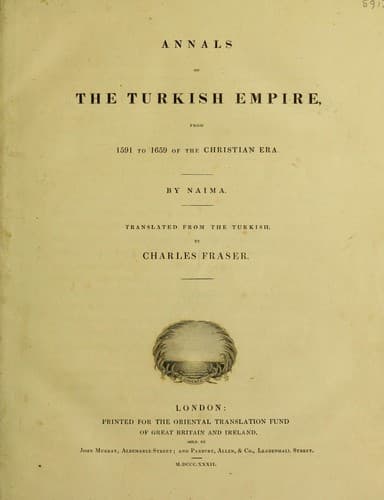
Annals of the Turkish Empire, from 1591 to 1659Naima, Mustafa
History
Annals of the Turkish Empire, from 1591 to 1659
Naima, Mustafa
Turkey -- History -- 1453-1683
When the emperor was made aware of these scenes of insubordination
and turbulence, he sent two military judges to exhort them to return
to their duty. These two prelates were the poet Bákí Effendí and
Abúlsa’úd, a principal effendí; but their exhortation to the mutineers
had no better result than the former. The mutineers stamped with their
feet on the ground, and again vociferated “The head of Ferhád!” Ferhád
was now induced to wait on his majesty and tell him how he had acted,
and how he had spoken to the instigators of the riots about their want
of subordination, which conduct manifested, he observed, their utter
want of religion. “Lála Mohammed Páshá and other vezírs were present
when I spoke to them,” said the grand vezír, “and I am sure nothing
of all that I said ought to have offended them. I am only one of your
slaves, and though I should be removed out of the world, that will
not reduce the number of your majesty’s councillors. To comply with
their demands will only have the effect of increasing their rebellious
spirit and open a door for making similar demands in future, which will
not be so easily resisted if their present one be complied with. At
the present moment, when neither exhortation nor threatening can make
any impression on them, it will be most advisable that your majesty
authorise the ághá of the Janissaries to bring out a considerable
number of his troops and station them below the arsenal, and order the
most powerful of the Bostánjís to be in a state of readiness at the
Tímúr gate. If, therefore, the vezírs be molested when they retire from
the diván, these troops will immediately, on the first signal, advance
and chastise the insurgents for their temerity.” The emperor approved
of this advice, and promised to act accordingly. He desired Ferhád
to remain with him, and that he would again send his vezírs to try to
pacify them. “If they succeed, well; if not, then your method will be
adverted to,” said he to his grand vezír, and ordered them to make the
endeavour. The vezírs, however, no sooner showed themselves, than the
audacious multitude commenced pelting them with stones as formerly.
At this moment the Janissaries and Bostánjís were let loose upon the
mutinous Spáhís, and dispersed them in all directions: not any two of
them remained together, so completely were they awed and terrified.
In this tumult the brother-in-law of Khalíl Páshá had his head hurt,
and Lála Mohammed Páshá his arms, by stones which were hurled at them.
Both of them were carried into the diván in a wounded condition by the
ághá of the Janissaries, who related to the members of the council how
matters stood, after which they all dismissed: Ferhád mounted his horse
and rode away to his own palace.
Public-domain text, read in full here on John Shaqi.
Reviews
Reviews
No reviews yet
Be the first to share your thoughts on this work.
Elsewhere in the archive
Join the Discussion
Join the discussion
Sign in to leave a comment or review.
Sign InorCreate an account