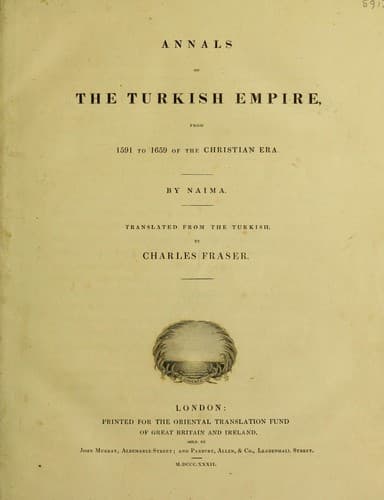
Annals of the Turkish Empire, from 1591 to 1659Naima, Mustafa
History
Annals of the Turkish Empire, from 1591 to 1659
Naima, Mustafa
Turkey -- History -- 1453-1683
In the history called _Bahjet_, the account is thus related:—The
Moslem army having halted in a marshy and woody spot near the bridge
of Kalúgirvan, were soon attacked by a body of the enemy, whose cannon
and small arms were most galling to them. In these circumstances,
Satúrjí Mohammed Páshá, Haider Páshá, Hasan Páshá, and Mustafa Páshá,
the son of Ayás Páshá, crossed the bridge with a considerable number of
troops, and attacked them in return, and after a most dreadful conflict
succeeded in securing ten of the enemy’s cannon, but were afterwards
obliged to retreat, leaving their acquisition behind them. Mohammed
Páshá, in the act of retreating, was wounded in the above-mentioned
marsh. Hasan Haider and Mustafa sunk into the mud and perished. The
grand vezír himself was also very unfortunate, for in this moment of
confusion and retreat, he too was obliged to fly; and in doing so, fell
into a morass. His body guards sought their own safety, and left him
to shift for himself the best way he could. He got out, but soon fell
into another; and in this predicament he continued till he was observed
by a veteran Romeilian called Hasan, who advanced towards him, took
him on his back, and thus carried him out of the marsh. This hero, the
deliverer of the grand vezír, acquired public fame for his heroism,
and had the word “marsh” affixed to his name ever afterwards. He was,
therefore, called Hasan Bátákjí, and became afterwards the commander of
a body of heroes under Khoja Murád Páshá, honourably mentioned in the
sequel of this history.
On the night of the above-mentioned disastrous event, one of the
Janissaries happened to lay down an unextinguished match upon some
gunpowder, which, when it ignited, communicated itself to a great
quantity of the same material which lay in its neighbourhood, and
which produced so tremendous an explosion as to cause an universal
cry of “Yá allah,” among the troops. The effect of this explosion on
the infidel army was astonishing—for they supposed they were attacked
by the Moslems, and to escape them they immediately retired. Michael
hastened to Bekrish with the greater part of his army, whilst a smaller
body made its way into Moldavia, but afterwards returned to join their
infamous leader at Bekrish.
The Moslems unable, in consequence of the fatigues they had endured
the preceding day, to take advantage of the flight of the enemy, and
thus gain the open field, retreated a little. Here they remained two
days, during which time some prisoners were brought in, who informed
them that the enemy had concentrated at Bekrish. Encouraged by this
information, Hasan Páshá, on the 18th of the month, crossed over with
his division, gained the plain beyond the valley or pass, and sent out
a foraging party through the country, who returned with provisions,
prisoners, and cattle.
Public-domain text, read in full here on John Shaqi.
Reviews
Reviews
No reviews yet
Be the first to share your thoughts on this work.
Elsewhere in the archive
Join the Discussion
Join the discussion
Sign in to leave a comment or review.
Sign InorCreate an account