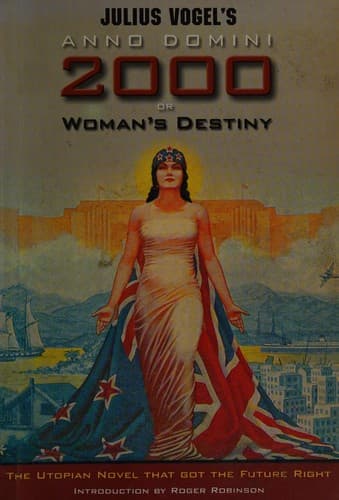
Anno Domini 2000; or, Woman's DestinyVogel, Julius, Sir
Science
Anno Domini 2000; or, Woman's Destiny
Vogel, Julius, Sir
Feminist fiction; New Zealand -- Fiction; Two thousand, A.D. -- Fiction; Utopian fiction; Utopias -- Fiction; Women -- Fiction
The evening of the meeting came, and for half an hour there were
numerous arrivals at the many doors of the huge building. Each person
had separately to interchange the pass-words at both the outer and inner
doors. At length about twelve hundred people were assembled. The lights
outside the glass hall were comparatively feeble. The powerful electric
lamps were not turned on. The inner hall was unlighted, and received
only a dull reflection from the outer lights. Some surprise was
expressed by the usual frequenters of the Hall at the appearance inside
the glass wall of a wooden dais, sufficiently large to hold three or
four people, and with shallow steps on one side leading up to it.
Inquiry was made as to its object. The doorkeeper, suitably instructed,
replied carelessly it was thought, they might require a stage from which
the speakers could address the audience. The present meeting certainly
did not want it. The speakers had no desire to individually bring
themselves into notice. Hilda, muffled up as were the rest, quietly took
a seat close to the steps of the dais. No president was appointed; no
one appeared to have any control; yet as the meeting proceeded it was
evident that its tactics had been carefully thought out, and that most,
if not all, of the speakers were fulfilling the parts allotted to them.
First a tall, elderly man rose, and with considerable force and fluency
enlarged upon the evils of the present large taxation. He went into
figures, and his speech ought to have been effective, only no one seemed
to take any interest in it. Then there loomed on the meeting the person
apparently of a middle-aged woman. The cloaks and hats carefully
mystified the identities of the sexes and individual peculiarities. This
speaker went a little further. She explained that maintaining the Empire
as a whole entailed the sacrifice of regulating the taxation so as to
suit the least wealthy portions. She carefully guarded herself from
being more than explanatory. The comparative poverty of England and the
exactions of the self-indulgent Londoners, she said, necessitated a
scale of taxation that hardy and rich Australia, New Zealand, and Canada
did not require. Then a historically disposed young woman rose and dwelt
upon the time when England thought a great deal more of herself than of
the Colonies and to curry favour with foreign countries placed them on
the same footing as her own dominions. Little by little various speakers
progressed, testing at every step the feelings of the audience, until at
last one went so far as to ask the question whether the time would ever
come when Australia would be found to be quite large and powerful enough
to constitute an empire of itself. "Mind," said he, "I do not say the
time will come." Then an apparently excited Australian arose. She would
not, she said, say a word in favour of such an empire; but she, an
Australian bred and born, and with a long line of Australian ancestors,
Public-domain text, read in full here on John Shaqi.
Reviews
Reviews
No reviews yet
Be the first to share your thoughts on this work.
Join the Discussion
Join the discussion
Sign in to leave a comment or review.
Sign InorCreate an account