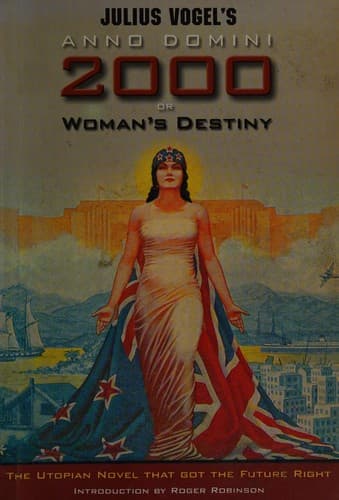
Anno Domini 2000; or, Woman's DestinyVogel, Julius, Sir
Science
Anno Domini 2000; or, Woman's Destiny
Vogel, Julius, Sir
Feminist fiction; New Zealand -- Fiction; Two thousand, A.D. -- Fiction; Utopian fiction; Utopias -- Fiction; Women -- Fiction
was not going to listen to any doubts being thrown on Australia or
Australians. The country and the people, she declared, amidst murmuring
signs of assent, were fit for any destiny to which they might be called.
Then a logical speaker rose and asked why were they forbidden to discuss
the question as to whether it was desirable to retain the present limits
of the Empire or to divide it. He would not state what his opinion was,
but he would say this: that he could not properly estimate the arguments
in favour of preserving the integrity of the Empire unless he was at
liberty to hear the arguments and answer them of those who held an
opposite opinion. When this speaker sat down, there was a momentary
pause. It seemed as if there was a short consultation between those who
were guiding the progress of the meeting. Whether or not this was the
case, some determination appeared to be arrived at; and a short, portly
man arose and said he did not care for anybody or anything. He would
answer the question to which they had at length attained by saying that
in his opinion the present empire was too large, that Australia ought to
be formed into a separate empire, and that she would be quite strong
enough to take care of herself.
The low murmur of fear with which this bold announcement was heard soon
developed into loud cheers, especially from that part of the Hall where
the controlling influence seemed to be held. Then all restraint was cast
aside; and speaker after speaker affirmed, in all varieties of
eloquence, that Australia must be an empire. Some discussed whether New
Zealand should be included, but the general opinion appeared to be that
she should be left to her own decision in the matter. Then the climax
was approached. A speaker rose and said there appeared to be no doubt in
the mind of the meeting as to the Empire of Australia; he hoped there
was no doubt that Lord Reginald Paramatta should be the first Emperor.
The meeting seemed to be getting beyond the control of its leaders. It
did not appear to have been part of their programme to put forward Lord
Reginald's name at this stage. It was an awkward fix, for no person by
name was supposed to be present, so that he could neither disclaim the
honour nor express his thanks for it. One of the controllers, a grave,
tall woman, long past middle age, dealt with this difficulty. They must
not, she said, go too far at first; it was for them now to say whether
Australia should be an empire. She loved to hear the enthusiasm with
which Lord Reginald Paramatta's name was received. Australia boasted no
greater or more distinguished family than the Paramattas; and as for
Lord Reginald, every one knew that a braver and better soldier did not
live. Still they must decide on the Empire before the Emperor, and each
person present must answer the question was he or she favourable to
Australia being constructed into a separate empire? They could not in
this light distinguish hands held up.
Public-domain text, read in full here on John Shaqi.
Reviews
Reviews
No reviews yet
Be the first to share your thoughts on this work.
Join the Discussion
Join the discussion
Sign in to leave a comment or review.
Sign InorCreate an account