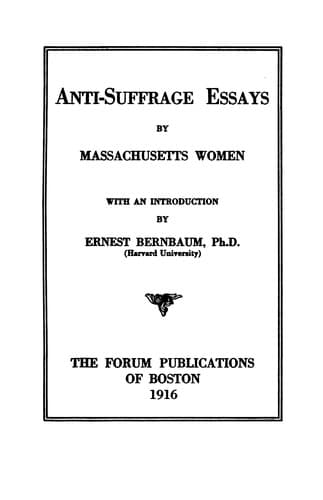
Women -- Massachusetts; Women -- Suffrage -- United States; Women's Anti-Suffrage Association of Massachusetts
In 1912, when the Children's Bureau was established at Washington, we
might have expected that one of the women constituents of the
petticoated West would be placed at its head. Instead, President Taft
appointed Miss Julia C. Lathrop, a resident of Hull House in Chicago,
and a former member of the Illinois State Board of Charities, where she
was credited with the enlargement of the Illinois State charitable
institutions and their thorough reorganization, though, of course,
obliged to work without the ballot. Time has proved the wisdom of Mr.
Taft's appointment and also borne witness to the peculiar advantage
enjoyed by women in politics, provided they are not shackled with the
ballot.
One of the thought-inspiring books of 1914 was also a splendid argument
for the anti-suffragists. It was _Beauty for Ashes_, Mrs. Albion
Fellowes Bacon's account of the securing of the Indiana Model Housing
Act, which was accomplished through the initiative and leadership of
this one woman, mother, and home-maker, with no political prestige, with
no previous reputation built by long publicity, without the all-powerful
ballot.
Mrs. Bacon was supported by the Federated Woman's Clubs of her State,
and enlisted the aid of earnest men and women citizens throughout the
State. Her bill was bitterly contested by the worst class of landlords,
but after three sessions of the Legislature, at which Mrs. Bacon was
obliged to appear in person and explain her bill, it was passed. She
says of that day: "The women, the homes of Indiana, were honored that
day by the men of the Legislature, and we had won a law for the 101
cities of our State. No wonder the women applauded as some of the men
who gave their reasons, added 'and because the women wanted it'." Her
conclusion is: "Most strongly have I desired to show how much can be
done by women's organizations by simply demanding right legislation, and
to show their equally important part of helping to enforce legislation
after they get it."
Speaking of her own work, she says: "Having no hand in the management of
political affairs, I may leave to the various political parties the care
of reaping the thorns in each other's fields. It has been my pleasand
task to gather only the grapes.... I have encountered more figs than
thistles, and fewer thistles than what seems to be a sort of cacti,
that, I firmly believe, might be Burbankized for human good. Would that
they might be, and that we might include in the conservation of vital
resources those great powers for good that are now so wasted by constant
warring for political supremacy."
That last sentence forms a scathing indictment of the shortsightedness
of suffrage policy. It is pitiful to think of the energy and ability
which today is diverted from channels of human helpfulness to this
sensational struggle for a mistaken cause. It is not to be thought of
that we can permit woman's energy to be permanently dissipated in
political warfare or handicapped by party vicissitudes.
Public-domain text, read in full here on John Shaqi.
Reviews
Reviews
No reviews yet
Be the first to share your thoughts on this work.
Join the Discussion
Join the discussion
Sign in to leave a comment or review.
Sign InorCreate an account