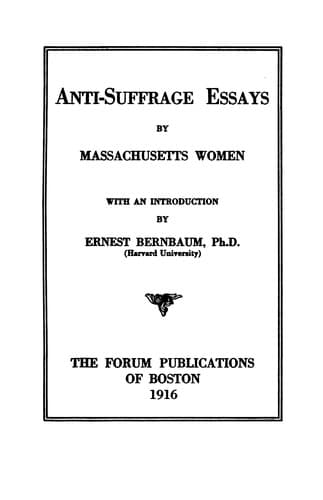
Women -- Massachusetts; Women -- Suffrage -- United States; Women's Anti-Suffrage Association of Massachusetts
Miss Jane Addams' achievements in Chicago at Hull House, are too widely
known to require any enumeration, but I would emphasize the fact that
her work was done while Illinois was still a male suffrage state. In
_Twenty Years at Hull House_, which was published in 1910, three years
before women attained partial enfranchisement in Illinois, Miss Addams
gives her estimate of the field of a settlement in social work for a
community: "It seems impossible to set any bounds to the moral
capabilities which might unfold under ideal civic and educational
conditions. But, in order to obtain these conditions, the Settlement
recognizes the need of cooperation, both with the radical and the
conservative, and from the very nature of the case, the Settlement
cannot limit its friends to any one political party or economic school."
Since these words were written, Miss Addams has allied herself
definitely with a political party, at great loss of personal prestige,
but that does not alter the truth of her written opinion. The end of
every public spirited woman is identical with that of the Settlement,
"to obtain ideal civic and educational conditions" for her community;
and "the very nature of the case," as Miss Addams says, demands that
they be not obliged to limit their friends to any one political party,
but remain free from political affiliations in order that their
disinterestedness may not be cavilled at.
Miss Lillian D. Wald's work as a district nurse at the Henry Street
tenement she chose to occupy on graduating from her training course as a
nurse showed the way to the efficient Visiting Nurses' Associations that
are being organized today all over the country, and also to the public
recognition of the value of instruction in health which is finding
expression in the staffs of nurses maintained in many cities by the
Board of Health and School Departments whose services are free to the
people. This humanitarian work manifestly had no connection with the
ballot.
Miss Kate Barnard, the "Girl Commissioner of Charities" in Oklahoma, is
a striking figure of our day. The neighboring state of Kansas is a woman
suffrage state, yet Miss Barnard seems to prefer residence in the male
suffrage state of Oklahoma and has done great things there. When
Oklahoma was admitted to statehood, it was Miss Barnard who wrote the
child labor, prison reform, and other humanitarian measures into the
State constitution; and she was made State Commissioner of Charities,
which position she holds today. Miss Barnard, too, recognizes the power
for evil of partisan politics. She is at present waging a bitter fight
for the property rights of the Indian wards of her state, and writing in
the _Survey_, says: "I want the people of the U.S. to stand by me until
the hand of _partisan politics_ is wrested from the control of Indian
affairs in Oklahoma and in the nation."
Public-domain text, read in full here on John Shaqi.
Reviews
Reviews
No reviews yet
Be the first to share your thoughts on this work.
Join the Discussion
Join the discussion
Sign in to leave a comment or review.
Sign InorCreate an account