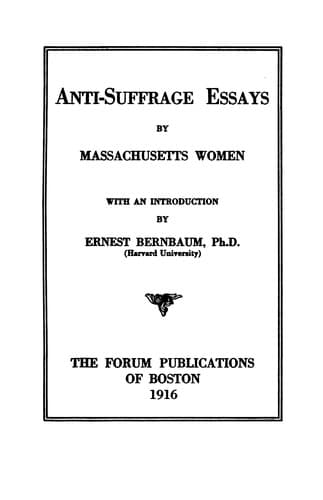
Women -- Massachusetts; Women -- Suffrage -- United States; Women's Anti-Suffrage Association of Massachusetts
The question for intelligent women to decide is whether or not they
_want_ this influence destroyed. If they wish to give up the moral
influence which a body of women, educated, public-spirited,
non-partisan, can wield--an influence so strong that legislators feel
obliged to make what the World calls "ridiculous concessions" to it--if
in its stead they wish to depend on political influence gained through
the ballot, which can be applied only to one party, which can be
entirely offset by the votes of women who are ignorant, boss-controlled,
and whose votes are purchasable--if they prefer that, they will get
their wish if woman suffrage wins. That is exactly how it is working out
in the suffrage states. In Wyoming the politicians were clever enough to
foresee this. Woman suffrage was granted by one of the most corrupt
legislatures Wyoming ever had. These men knew that at that time good
women were few in that sparsely settled State, and they knew they could
"manage the others."
Nevada is offering us a most perfect example of the good woman's loss of
influence by entering politics. The easy divorce laws of that state, in
force until three years ago, were a national scandal. This was realized
by certain women of the state, who in consequence brought their moral
influence to bear upon the legislature for the repeal of these laws.
Their efforts were successful and the laws were repealed. Woman suffrage
was granted in Nevada last fall, and one of the very first acts of the
legislature was to re-enact the easy divorce laws! These women again
protested, but with no success. They were now voters, and the
legislature knew perfectly well that plenty of women's votes could be
secured to offset those of the protesting women. The moral influence of
this minority of Nevada women who cared for social betterment was gone
since the vote had been given to all women.
In her admirable anti-suffrage address before the Maine legislature at
the recent hearing on suffrage, Mrs. J. F. A. Merrill said:
"What do men do when they want to bring about a reform?
"They do as the men of Portland did a short time ago, when a number of
citizens became convinced that the moral conditions in Portland were not
what they should be. And what did they do? Did they vote about it? Did
they form party organizations? No; they resorted as nearly as they
could, to what is known as 'women's methods,' and formed a non-partisan
citizen's committee, just as detached as possible from politics. And why
did they resort to women's methods? Simply because they had all had the
vote since coming of age, and they all knew how useless it is as a means
of accomplishing reform work.
Public-domain text, read in full here on John Shaqi.
Reviews
Reviews
No reviews yet
Be the first to share your thoughts on this work.
Join the Discussion
Join the discussion
Sign in to leave a comment or review.
Sign InorCreate an account