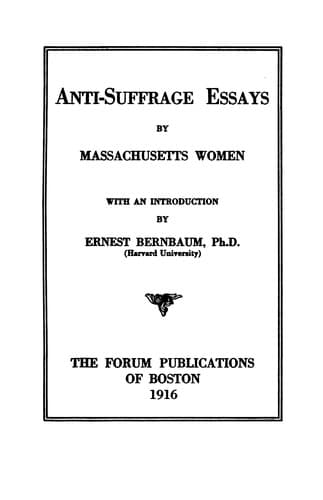
Women -- Massachusetts; Women -- Suffrage -- United States; Women's Anti-Suffrage Association of Massachusetts
"The first mayoralty campaign in which women voters participated failed
to develop the refining and elevating influence which the sex was
expected to exert. When one sees a woman of dignified presence and
cultivated appearance greeted with torrents of hisses and insults from
the frenzied lips of both men and women; when one sees her finally
driven from the platform with no chance of speaking a word, one is
tempted to retire to some quiet spot for a moment and meditate on what
it all means.
"When one watches a venerable lady trying to quell the tumult by waving
a flag and almost dancing to the same rhythm, while 1,200 shrieking men
and women order her to 'sit down and chase herself,' one remembers his
own grandmother, and makes a feeble effort to blush. One is almost
tempted to pick that discarded and discredited old relic once known as
masculine chivalry out of the scrap heap, and see how many people would
recognize it."
These references are to a woman's political mass meeting, which was
described in a Chicago despatch to the Boston Herald as follows:
"A demonstration approaching a riot marked the women's political meeting
here today, and was ended only when the managers of the theatre where
the meeting was held dropped the steel curtain and a spectator sent in a
riot call for the police."
Does this sort of thing tend to increase woman's influence in uplifting
and benefiting her community?
A suffrage writer said recently that the son who grows up to find his
mother a voter will have a broadened respect for womanhood. With these
scenes in Chicago in mind, do you think he will? Suppose she has just
voted for Bath-House John, the notorious candidate who got a majority of
the women's votes in his ward, or in favor of saloons, as thousands of
women have done--will he have added respect for her? This same writer
says: "It might be a new and stimulating experience for a man to have to
explain to his wife just why he was voting on the side of a corrupt
boss, in favor of the liquor traffic, or against the suppression of
child labor." But if she had just done those things herself--and in
Chicago the women voted just as the men did--why should the experience
be a stimulating one?
Jane Addams, while on her foreign mission of "Peace--with suffrage" said
in London, on May 12, 1915:
"I am a strong supporter of woman suffrage, and, although I hope to see
the women of England enfranchised, I see around me endless opportunities
for social work which could be usefully performed while the vote is
being won."
Public-domain text, read in full here on John Shaqi.
Reviews
Reviews
No reviews yet
Be the first to share your thoughts on this work.
Elsewhere in the archive
Join the Discussion
Join the discussion
Sign in to leave a comment or review.
Sign InorCreate an account