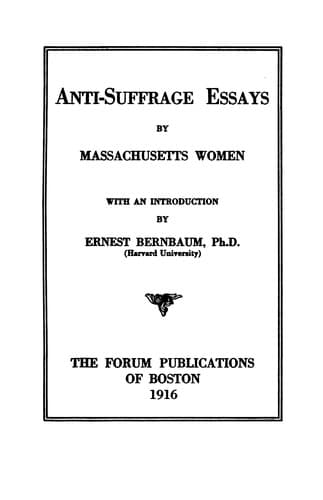
Women -- Massachusetts; Women -- Suffrage -- United States; Women's Anti-Suffrage Association of Massachusetts
Men who believe in fair play will refuse to force political life upon
all the women of their states because a small fraction think they want
it. Those who care for the political welfare of their states will
decline to adopt this innovation, which assuredly cannot stand the tests
of rational criticism and of experience. If they value in the slightest
degree the assistance which educated, public-spirited women are able to
give in securing enlightened legislation, they will certainly not favor
votes for women; for what woman suffrage does is to take the power out
of the hands of these women, who without the vote exert a strong moral
influence toward good legislation, and put the power gained through an
increase in the electorate into the hands of the bosses who can control
the largest woman's vote.
"Practical politicians" are learning this lesson rapidly. The New York
Commercial calls attention to the fact that in our cities the female
vote is more easily manipulated than the male. This fact does not
escape the bosses, and they are rapidly coming into line for woman
suffrage. While woman suffrage was largely an untried theory suffragists
could maintain with some plausibility that woman's vote would be cast
for moral and humane legislation, and would purify politics; but with
the actual conditions in Chicago, San Francisco, Reno, Denver, and
Seattle what they are, this theory no longer holds water, and it is
becoming increasingly evident that the way to do away with the moral
influence of women in public life is to give the vote to all women.
XIII
THE ANTI-SUFFRAGE IDEAL
MRS. HERBERT LYMAN
_Ruth Whitney Lyman, wife of Herbert Lyman; studied two years at
Bryn Mawr; a member of the Woman's Municipal League of Boston and
of the Board of Directors of the North End Diet Kitchen._
_J. A. H._
Women today find their sex disquieted by deep unrest. Our sex is seeking
to adjust itself to new conditions. Suffrage, feminism, militancy, have
been the symptoms of the first phase of modern woman's attempt to adjust
herself to twentieth century conditions. That phase was the outgrowth of
hasty judgment, and is rapidly giving place to the second phase, wherein
the sober second thought of the normal woman is repudiating the false
values preached by those women who impulsively leaped to the conclusion
that man's sphere was more potent than woman's and therefore more
desirable.
The struggle over woman suffrage presents the spectacle of two camps of
women arrayed against each other with opposing ideals. Let no one be so
simple as to suppose that the issue is one between men and women. It is
not a "woman's rights" question; it is a _which_ woman's rights
question. Two types of women are at war, for although both desire the
same end--namely, a better world to live in--they differ fundamentally
as to the method of attaining it.
Public-domain text, read in full here on John Shaqi.
Reviews
Reviews
No reviews yet
Be the first to share your thoughts on this work.
Elsewhere in the archive
Join the Discussion
Join the discussion
Sign in to leave a comment or review.
Sign InorCreate an account