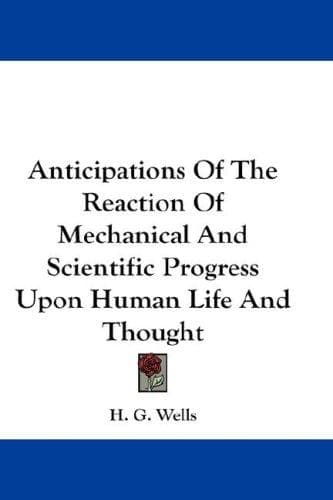
Anticipations of the reaction of mechanical and scientific progress upon human life and thoughtWells, H. G. (Herbert George)
History
Anticipations of the reaction of mechanical and scientific progress upon human life and thought
Wells, H. G. (Herbert George)
Civilization; Communication and traffic; Social prediction; Twentieth century -- Forecasts
The mere fact that a man is an engineer or a doctor, for example, should
imply now, and certainly will imply in the future, that he has received
an education of a certain definite type; he will have a general
acquaintance with the scientific interpretation of the universe, and he
will have acquired certain positive and practical habits of mind. If the
methods of thought of any individual in this central body are not
practical and positive, he will tend to drift out of it to some more
congenial employment. He will almost necessarily have a strong
imperative to duty quite apart from whatever theological opinions he may
entertain, because if he has not such an inherent imperative, life will
have very many more alluring prospects than this. His religious
conclusions, whatever they may be, will be based upon some orderly
theological system that must have honestly admitted and reconciled his
scientific beliefs; the emotional and mystical elements in his religion
will be subordinate or absent. Essentially he will be a moral man,
certainly so far as to exercise self-restraint and live in an ordered
way. Unless this is so, he will be unable to give his principal energies
to thought and work--that is, he will not be a good typical engineer. If
sensuality appear at all largely in this central body, therefore,--a
point we must leave open here--it will appear without any trappings of
sentiment or mysticism, frankly on Pauline lines, wine for the stomach's
sake, and it is better to marry than to burn, a concession to the flesh
necessary to secure efficiency. Assuming in our typical case that pure
indulgence does not appear or flares and passes, then either he will be
single or more or less married. The import of that "more or less" will
be discussed later, for the present we may very conveniently conceive
him married under the traditional laws of Christendom. Having a mind
considerably engaged, he will not have the leisure for a wife of the
distracting, perplexing personality kind, and in our typical case, which
will be a typically sound and successful one, we may picture him wedded
to a healthy, intelligent, and loyal person, who will be her husband's
companion in their common leisure, and as mother of their three or four
children and manager of his household, as much of a technically capable
individual as himself. He will be a father of several children, I think,
because his scientific mental basis will incline him to see the whole of
life as a struggle to survive; he will recognize that a childless,
sterile life, however pleasant, is essentially failure and perversion,
and he will conceive his honour involved in the possession of offspring.
Public-domain text, read in full here on John Shaqi.
Reviews
Reviews
No reviews yet
Be the first to share your thoughts on this work.
Elsewhere in the archive
Join the Discussion
Join the discussion
Sign in to leave a comment or review.
Sign InorCreate an account