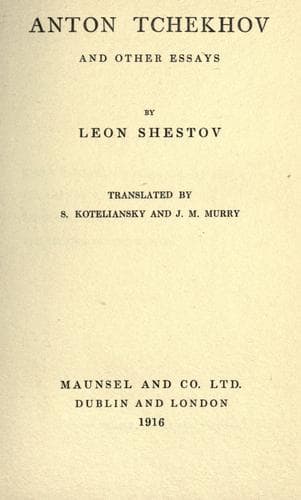
Chekhov, Anton Pavlovich, 1860-1904; Dostoyevsky, Fyodor, 1821-1881; Philosophy; Russian literature -- History and criticism
of good upon the earth (though it would be an absolute miracle), in
progress or the infallibility of the Pope (these too are miracles and
by no means inconsiderable), for after all men are quite sufficiently
indifferent to good, to progress, and to the virtues of the Pope. It
is much harder, nay quite impossible, standing before the dead body of
one who is near and dear, to believe that an angel will fly down from
heaven and bring the dead to life again, although the world is full of
happenings no less miraculous than the raising of the dead.
Therefore the sceptics are wrong when they assert that there is no
truth. Truth exists, but we do not know it in all its volume, nor can
we formulate that which we do know: we cannot imagine why it happened
thus and not otherwise, or whether that which happened had to happen
thus, or whether something else quite different might have happened.
Once it was held that reality obeys the laws of necessity, but Hume
explained that the notion of necessity is subjective, and therefore
must be discarded as illusory. His idea was caught up (without the
deduction) by Kant. All those of our judgments which have the character
of universality and necessity, acquire it only by virtue of our
psychological organisation. In those cases where we are particularly
convinced of the objective value of our judgment, we have merely
to do with a purely subjective certainty, though it is immutable
and secure in the visible world. It is well known that Kant did not
accept Hume's deduction: not only did he make no attempt to banish the
false premisses from our intellectual economy, as Hume did with the
conception of necessity, but, on the contrary, he declared that such
an attempt was quite impracticable. The practical reason suggested to
Kant that though the foundations of our judgments are vitiated by their
source, yet their invariability may be of great assistance in the world
of phenomena, that is in the space between the birth and death of man.
If a man has lived before birth (as Plato held), and will live after
death, then his 'truths' were not, and will not be necessary there,
in the other world. What truths are _there,_ and whether there are
any truths at all, Kant only guesses, and he succeeds in his guesses
only because of his readiness to ignore logic in his conclusions. He
suddenly gives faith an immense right to judge of the real world, a
right of which faith would never dream had it not been taken under his
special patronage by the philosopher himself. But why can faith do that
which reason cannot? And a yet more insidious question: Are not all
postulates invented by the same mind which was deprived of its rights
in the first Critique, but which subsequently obtained a verdict of
_restitutio in integrum,_ by changing the name of the firm? The last
hypothesis is the most probable. And if so, then does it not follow
that in the real world so carefully divided by Kant from the world of
Public-domain text, read in full here on John Shaqi.
Reviews
Reviews
No reviews yet
Be the first to share your thoughts on this work.
Join the Discussion
Join the discussion
Sign in to leave a comment or review.
Sign InorCreate an account