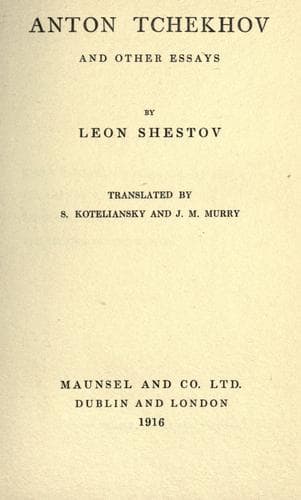
Chekhov, Anton Pavlovich, 1860-1904; Dostoyevsky, Fyodor, 1821-1881; Philosophy; Russian literature -- History and criticism
phenomena we will find much that is new, but not a little that is old.
In general it is clear that the assumption that our world is a world
of an instant, a brief dream, utterly unlike real life, is mistaken.
This assumption, first enunciated by Plato, and afterwards elaborated
and maintained by many representatives of religious and philosophical
thought, is based upon no data at all. There's no denying, it is very
pleasant. But as often happens, as soon as the wish was invested
with language, by the mere fact it received too sharp and angular an
expression, so that it lost all resemblance to itself. The essence
of the true, primordial life beyond the grave appears to Plato as
absolute good refined from all alloy, as the essence of virtue.
But after all Plato himself cannot suffer the absolute emptiness
of the ideal existence, and constantly flavours it with elements
which are by no means ideal, but which give interest and intensity
to his dialogues. If you have never had the occasion to read Plato
himself, acquaint yourself with his philosophy through the teaching
of any of his admirers and appreciators, and you will be struck by
its emptiness. Read the thick volume of Natorp's well-known work,
and you will see what value there is in Plato's 'purified' doctrine.
And in passing I would recommend as a general rule, this method of
examining the ideas of famous philosophers, by acquainting oneself with
them not only in the original works, but in the expositions of their
disciples, particularly of faithful and conscientious disciples. When
the fascination of the personality and the genius disappears and the
naked, unadorned 'truth' remains--disciples always believe that the
master had the truth, and they reveal it without any embellishment or
fig leaf--only then does it become quite clear of how little value
are the fundamental thoughts of even the most exalted philosophers.
Still more obvious does it become when the faithful disciple begins
to draw conclusions from his master's proportions. The book of the
aforesaid Natorp, a great Plato expert, is a _reductio ad absurdum_
of all his master's ideas. Plato is revealed as a logical Neo-Kantian,
a narrow-minded savant, who had been put thoroughly through the mill
at Freiburg or Heidelberg. It is also revealed that Plato's ideas, in
the pure state, do not in the least express his real attitude to life
and to the world. One must take the whole Plato with his contradictions
and inconsequence, with his vices and virtues, and value his defects at
least as much as his qualities, or even add one or two defects, and be
blind to one or two virtues. For it is probable that he, as a man to
whom nothing human was alien, tried to assume a few virtues which he
did not possess, and to conceal a few failings. This course should be
followed with other masters of wisdom and their doctrines. Then 'the
other world' will not appear to be separated by such an abyss from our
earthly vale.
Public-domain text, read in full here on John Shaqi.
Reviews
Reviews
No reviews yet
Be the first to share your thoughts on this work.
Join the Discussion
Join the discussion
Sign in to leave a comment or review.
Sign InorCreate an account