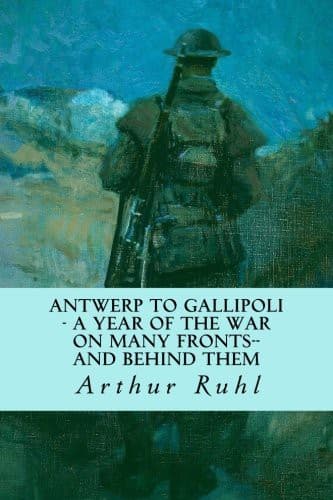
Antwerp to Gallipoli: A Year of the War on Many Fronts—and Behind ThemRuhl, Arthur
History
Antwerp to Gallipoli: A Year of the War on Many Fronts—and Behind Them
Ruhl, Arthur
World War, 1914-1918 -- Personal narratives
Walking about town after breakfast, I ran into a young man whom I had
last seen in a white linen uniform, waiting patiently on the orderlies'
bench of the American Ambulance at Neuilly. The ambulance is as hard to
get into as an exclusive club, for the woods are full these days of
volunteers who, leading rather decorative lives in times of peace, have
been shaken awake by the war into helping out overtaxed embassies,
making beds in hospitals, doing whatever comes along with a childlike
delight in the novelty of work. This young man wore a Red Cross button
now and paused long enough to impart the following--characteristic of
the things we non-combatants hear daily, and which, authentic or not,
help to "make life interesting":
1. An English general just down from the front had told him that four
thousand soldiers had been sent out as a burial party after the fighting
along the Yser, and had buried, by actual count, thirty-nine thousand
Germans.
2. In a temporary hospital near the front some fifty German and Indian
wounded were put in the same ward. In the night the Indians got up and
cut the Germans' throats.
I climbed up through narrow, cobblestoned streets to the higher part of
the town. It was pleasant up here in the frosty morning--old houses,
archways, and courts, and the bells tolling people to church.
Up the long hill, as I went down, came three hearses in black and
silver, after the French fashion, with drivers in black coats and
black-and-silver cocked hats. People stopped as they passed, a woman
crossed herself, men took off their hats--farther up the hill a French
sentry suddenly straightened and presented arms.
The three caskets were draped in flags--not the tricolor, but the Union
Jack. No mourners followed them, and as the ancient vehicles climbed
over the brow of the hill the people kept looking, feeling, perhaps,
that something was lacking, wondering who the strangers might be who had
given their lives to France.
Monday.
Paris again--a gray Paris, with bare tree-trunks, dead leaves on the
sidewalk, and in the air the chill of approaching winter.
Across the gray distances one fancies now and then to have seen the
first stray flakes of snow, and in some old street, between tall, gray
houses leaning backward, sidewise, each after its fashion--as some girl,
pale, with shawl wrapped about her shoulders, hurries past with a quick
upcasting of dark eyes, one thinks of Mimi and the third act of "La
Boheme."
Public-domain text, read in full here on John Shaqi.
Reviews
Reviews
No reviews yet
Be the first to share your thoughts on this work.
Join the Discussion
Join the discussion
Sign in to leave a comment or review.
Sign InorCreate an account