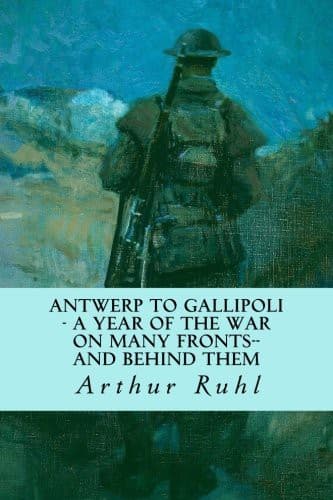
Antwerp to Gallipoli: A Year of the War on Many Fronts—and Behind ThemRuhl, Arthur
History
Antwerp to Gallipoli: A Year of the War on Many Fronts—and Behind Them
Ruhl, Arthur
World War, 1914-1918 -- Personal narratives
Old sentiments, old songs and verses return in this strange, gray
stillness--that spirit so gracious, delicate, penetrating, and personal,
which has drawn so many through the years, becomes more moving and real.
There is more animation in the streets now: shops are opening, cabs
tooting down the Avenue de l'Opera the greater part of the night; but
most of the house-fronts are still shuttered and still. Tourists,
pleasure-seekers, and the banalities they bring are gone--every thought
and energy is with the men fighting on that long line across the north.
It is a Paris of the French--of a France united as never before,
perhaps, purified by fire, ardent, resolute, defending her life and her
precious inheritance.
The Temporary Capital
Tuesday.
A journalist actually protests in print against the big loaves of coarse
bread, long as half a stick of cord-wood and almost as hard--remember
the almost carnivorous joy with which a Frenchman devours bread!--to
which the military government, at the beginning of the war, condemned
Paris.
The explanation was that rolls and fancy bread took too much time and
there were not enough bakers left to do the work--and inspectors see
that the law is obeyed, whether amiable bakers think they have time or
not. And people want light bread, curly rolls, "pain de fantaisie." All
very well for General Gallieni! says the journalist; he likes hard
bread; but why must several million people go on cracking their teeth
because of that idiosyncrasy?
The government is obdurate. If fancy bread were made, only the big
bakers would have time to make it, little ones would be without clients,
and that this highly centralized, paternal government cannot allow.
Hard bread it is, then, for another while at least--"C'est la guerre!"
Thursday.
We have a dining-car on our Bordeaux express to-day, the first since war
was declared. To-morrow night sleeping-cars go back again--more
significant than one might think who had not seen the France of a few
months ago, when everything was turned over to the army and people sat
up all night in day coaches to cover the usual three hours from Dieppe
to Paris.
Down through the heart of France--Tours, Poitiers, Angouleme--past trim
little French rivers, narrow, winding, still, and deep, with rows of
poplars close to the water's edge, and still a certain air of coquetry,
in spite of bare branches and fallen leaves--past brown fields across
which teams of oxen, one sedate old farm horse in the lead, are drawing
the furrow for next spring's wheat. It's the old men who are ploughing
--except for those in uniform, there is scarce a young man in sight. And
everywhere soldiers--wounded ones bound for southern France, reserves
not yet sent up.
Vines begin to appear, low brown lines across stony fields; then, just
after dark, across the Garonne and into Bordeaux, where the civil
government obligingly fled when the enemy was rolling down on Paris in
the first week of September.
Bordeaux, Monday.
Public-domain text, read in full here on John Shaqi.
Reviews
Reviews
No reviews yet
Be the first to share your thoughts on this work.
Join the Discussion
Join the discussion
Sign in to leave a comment or review.
Sign InorCreate an account