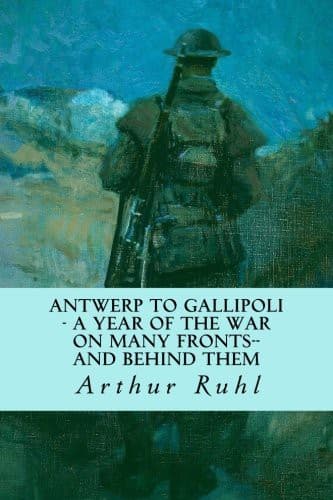
Antwerp to Gallipoli: A Year of the War on Many Fronts—and Behind ThemRuhl, Arthur
History
Antwerp to Gallipoli: A Year of the War on Many Fronts—and Behind Them
Ruhl, Arthur
World War, 1914-1918 -- Personal narratives
There must be plenty of real work, for an army like that of France,
stretching clear across the country from Switzerland to the Channel,
could not live unless it had a smoothly running civil machine in the
quiet country behind. Neither of the chambers is in session, and except
that the main streets are busy--one is told that one hundred thousand
extra people are in town--you might almost never know that anything out
of the ordinary had occurred. Things must be very different, of course,
from '71, when, beaten to her knees and threatened with revolution,
France had to decide between surrendering Alsace and Lorraine and going
on with the war.
The theatres are closed, but there are moving-picture shows, an
occasional concert, and twice a week, under the auspices of one of the
newspapers, a conference. I went to one of these, given by a French
professor of English literature in the University of Bordeaux, on the
timely subject: "Kipling and Greater England."
You can imagine the piquant interest of the scene--the polite matinee
audience, the row of erudite Frenchmen sitting behind the speaker, the
table, the shaded lamp, and the professor himself, a slender, dark
gentleman with a fine, grave face, pointed black beard, and penetrating
eyes--suggesting vaguely a prestidigitateur--trying, by sheer
intelligence and delicate, critical skill, to bridge the gaps of race
and instinctive thought and feeling and make his audience understand
Kipling.
Said the reporter of one of the Bordeaux papers next day: "Through the
Kipling evoked by M. Cestre we admired the English and those who fight,
in the great winds of the North Sea, that combat rude and brave. We
admired the faithful indigenes, gathering from all her dominions, to put
their muscular arms at the service of the empire..."
It would, indeed, have been difficult to pay a more graceful compliment
to the entente cordiale than to try to run the author of "Soldiers
Three" and the "Barrack Room Ballads," and with him the nation behind
him, into the smooth mould of a conference--that mixture, so curiously
French, of clear thinking and graceful expression, of sensitive
definition and personal charm, all blended into a whole so
intellectually neat and modulated that an audience like this may take it
with the same sense of being cheered, yet not inebriated, with which
their allies across the Channel take their afternoon tea.
Public-domain text, read in full here on John Shaqi.
Reviews
Reviews
No reviews yet
Be the first to share your thoughts on this work.
Join the Discussion
Join the discussion
Sign in to leave a comment or review.
Sign InorCreate an account