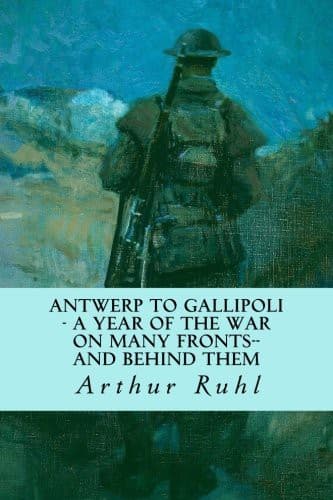
Antwerp to Gallipoli: A Year of the War on Many Fronts—and Behind ThemRuhl, Arthur
History
Antwerp to Gallipoli: A Year of the War on Many Fronts—and Behind Them
Ruhl, Arthur
World War, 1914-1918 -- Personal narratives
You can imagine what this slashing old privateer would do with a letter
like this. The censor will not permit him to make any comment. Very
well--he wishes to make none. "You see, Mr. Viviani, it isn't one of
those execrable parliamentarians who makes these complaints. It is a
mayor, a humble mayor, officially designated by you to transmit to his
people the striking results of your 'organization,' of your
'administration,' of your 'intensification' in the cruelly delicate
matter of giving news to families. He supplies the picture, and you see
in plain daylight your 'intensification' at work. What do you think of
it? What can you say about it? Do you believe that because you have
given to your censor the right--pardon me, the power--to make white
spaces in the columns of newspapers that that is going to suppress the
fact? Do you believe," etc., etc.
In the same editorial was a letter from a father whose two sons, on the
firing-line, had received none of the family letters since the beginning
of the war and wrote pathetically asking if their parents and little
sister were ill, or how they had offended. A wife enclosed a letter
from her husband, telling how he was suffering from the cold because of
insufficient clothing; a doctor wrote protesting because there was not a
single bottle of antitetanic serum in his field-hospital.
We found M. Clemenceau in his lodgings late one afternoon--a leonine old
gentleman bundled up in cap and overcoat before a little grate fire,
while a secretary ran through the big heap of letters piled on the bed.
In the corner of the room was a roll-top desk--the sanctum, evidently,
of The Chained Man.
As M. Clemenceau was insistent that he should not be interviewed, I may
not repeat the exceedingly lively talk on all sorts of people and things
with which he regaled us once--and it didn't take long--he "got going."
One purely personal little bit of information may be passed on, however,
in the hope that it may be as interesting to other practitioners of a
laborious trade as it was to me.
We were talking of the facility with which he reeled off, day after day,
columns of lively, finished prose, and I asked whether he wrote in
longhand, dictated, or used a typewriter.
This question seemed to amuse and interest the old war-horse greatly. He
went to his desk and brought back a sheet of paper, half of which was
covered with a small, firm handwriting. It was his next day's
broadside, not yet finished.
Public-domain text, read in full here on John Shaqi.
Reviews
Reviews
No reviews yet
Be the first to share your thoughts on this work.
Join the Discussion
Join the discussion
Sign in to leave a comment or review.
Sign InorCreate an account