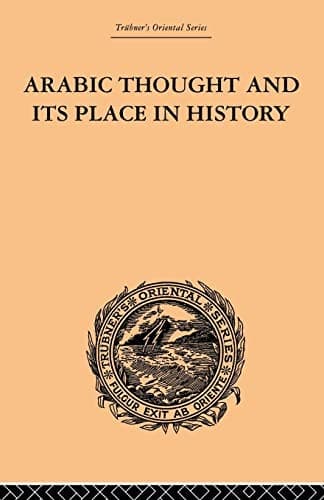
Arabic Thought and Its Place in HistoryO'Leary, De Lacy
ReligionIslamic
Arabic Thought and Its Place in History
O'Leary, De Lacy
Philosophy, Arab
Persians, no less careful about genealogical records, to which their
caste system had caused them to pay considerable attention, boasted
authentic genealogies of much greater antiquity. In literature, in
science, in Muslim canon law, in theology, and even in the scientific
treatment of Arabic grammar, the Persians very rapidly surpassed the
Arabs, so that we must be careful always to refer to Arabic philosophy,
Arabic science, etc., in the history of Muslim culture, rather than
to Arab philosophy, etc., remembering that, though expressed in the
Arabic language, the common medium of all the Muslim world, only in a
very few cases was it the work of Arabs: for the most part the Arabic
philosophers and scientists, historians, grammarians, theologians,
and jurists were Persians, Turks, or Berbers by birth, though using
the Arabic language. The fall of the `Umayyads and the replacing
of the Arabs by the Persians commences the golden age of Arabic
literature and scholarship. The older Arabic literature, that namely
which was written by Arabs as yet untouched by external influences,
consists entirely of poetry, the work of professional bards who sing
of desert life and warfare, lament over the deserted camping grounds,
boast of their tribe, and abuse their enemies. It forms a distinct
class of poetic composition, which has developed its own literary
standards, and attained a high standard of excellence in its way. In
many respects this older Arab poetry makes a special appeal to us,
it shows an observation of nature which is very striking, it has an
undercurrent of melancholy which seems an echo of the desert, and an
emotional side which seems convincing in its reality. At the same time
it has very distinct limitations in its range of interest and subject
matter. Undoubtedly a careful study of this early Arab poetry is a
necessary preparation for a proper appreciation of the literary forms
of Arabic and of its oldest vocabulary and syntax, and of recent years
much attention has been given to it. But this older Arabic poetry,
apparently a native production, but possibly influenced in pre-Islamic
times by some external contacts as yet undefined, comes to an end soon
after the fall of the `Umayyads, save in Spain, where, under the exiled
and fugitive remnant of the `Umayyad dynasty, the production of such
poetry survived. But this type of poetry is really outside our present
enquiry, save to note that it was a Persian scholar, Hammad b. Sabur
ar-Rawiya (d. circ. 156-159) who collected and edited the seven ancient
Arabic poems known as the _Mu`allaqat_ or “suspended,” i.e., the catena
or series, and thus set what may be called the classical standard of
the ancient poetry and vocabulary. At the accession of the Abbasids the
old Arab type passes away and the intellectual guidance of the Muslim
community passes into the hands of the Persians.
CHAPTER IV
THE TRANSLATORS
Public-domain text, read in full here on John Shaqi.
Reviews
Reviews
No reviews yet
Be the first to share your thoughts on this work.
Join the Discussion
Join the discussion
Sign in to leave a comment or review.
Sign InorCreate an account