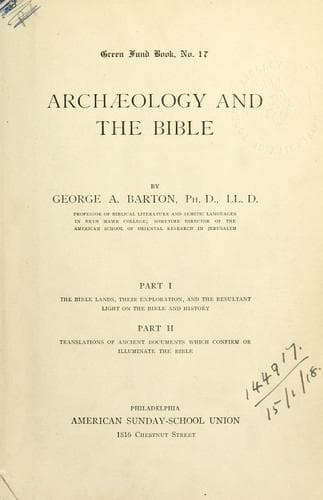
Archæology and the BibleBarton, George A. (George Aaron)
Religion
Archæology and the Bible
Barton, George A. (George Aaron)
Bible -- Antiquities; Egypt -- Antiquities; Middle East -- Antiquities
Hezekiah obeyed the summons and paid a heavy
tribute. Space does not permit us to speak of the wars of Sennacherib
against Elam and other countries.
It would seem that after Tirhakah ascended the throne of Egypt in 688 B.
C., he persuaded the kingdoms of Palestine to rebel. The Assyrian came
west again and threatened to invade Egypt and to destroy Jerusalem. Isaiah
then predicted that Jerusalem would be delivered (Isa. 31:5), a prediction
which was fulfilled. Sennacherib’s army was attacked by bubonic plague and
was compelled to retire.[15]
Sennacherib was assassinated in 681 and was succeeded by his son,
Esarhaddon, who ruled till 668. Esarhaddon rebuilt Babylon, which his
father had destroyed, and two years before his death conquered all of
Lower Egypt and made it an Assyrian province. During his reign a great
horde of Scythians poured into Asia through the Caucasus region from
southern Russia. The Assyrian army prevented Assyria from being
overwhelmed by this horde. The stream of invaders was divided, one part
flowing east to Media, the other part westward to Asia Minor.
Esarhaddon’s son and successor, Ashurbanipal, ruled from 668 to 626. His
reign was the Augustan age of Assyria. At the beginning he was called upon
to put down a rebellion in Egypt, and as trouble there recurred several
times, trouble which was fomented by emissaries from Thebes and Nubia, he
finally in 661 pushed up the Nile and conquered Thebes and gave it over to
plunder. (See Nahum 3:8.) Space does not permit us to follow
Ashurbanipal’s wars. About the middle of his reign his brother,
Shamash-shumukin, who was ruling Babylon, rebelled along with many other
vassals, and although the rebels were finally put down, the seeds of the
decay of Assyria’s power were sown. Manasseh, King of Judah, as long as he
lived was a faithful vassal of Esarhaddon and Ashurbanipal. (Cf. 2 Kings
19:37; 2 Chron. 33.)
The great work of Ashurbanipal was the collection of his library at
Nineveh. He sent to all the old temples of Babylonia and had copies made
of their incantations, hymns, and epics. These, together with chronicles,
medical tablets, dictionaries, etc., he collected in his palace, where
they were found by Layard and Rassam, and form the basis of our knowledge
of the Assyrian and Babylonian language, literature, and history. With the
death of Ashurbanipal, the last Assyrian period had really closed. Though
the kingdom continued for twenty years more, they were but the years of a
lingering death.
Public-domain text, read in full here on John Shaqi.
Reviews
Reviews
No reviews yet
Be the first to share your thoughts on this work.
Join the Discussion
Join the discussion
Sign in to leave a comment or review.
Sign InorCreate an account