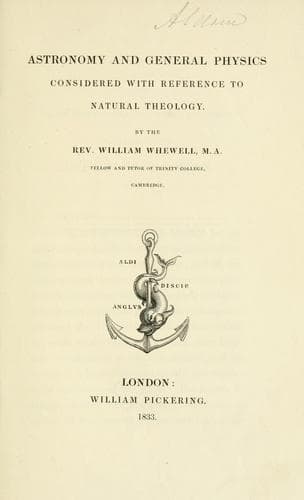
Astronomy and General Physics Considered with Reference to Natural Theology — John Shaqi
Astronomy and General Physics Considered with Reference to Natural TheologyWhewell, William
Religion
Astronomy and General Physics Considered with Reference to Natural Theology
Whewell, William
Astronomy; Cosmic physics; Natural theology
We have spoken of the steady average of the climate at each place,
of the difference of this average at different places, and of the
adaptation of organized beings to this character in the laws of
the elements by which they are affected. But this steadiness in
the general effect of the elements, is the result of an extremely
complex and extensive machinery. Climate, in its wider sense,
is not one single agent, but is the aggregate result of a great
number of different agents, governed by different laws, producing
effects of various kinds. The steadiness of this compound agency is
not the steadiness of a permanent condition, like that of a body
at rest; but it is the steadiness of a state of constant change
and movement, succession and alternation, seeming accident and
irregularity. It is a perpetual repose, combined with a perpetual
motion; an invariable average of most variable quantities. Now, the
manner in which such a state of things is produced, deserves, we
conceive, a closer consideration. It may be useful to show how the
particular laws of the action of each of the elements of climate
are so adjusted that they do not disturb this general constancy.
The principal constituents of climate are the following:--the
temperature of the earth, of the water, of the air:--the
distribution of the aqueous vapour contained in the
atmosphere:--the winds and rains by which the equilibrium of the
atmosphere is restored when it is in any degree disturbed. The
effects of light, of electricity, probably of other causes also,
are no doubt important in the economy of the vegetable world,
but these agencies have not been reduced by scientific inquirers
to such laws as to admit of their being treated with the same
exactness and certainty which we can obtain in the case of those
first mentioned.
We shall proceed to trace some of the peculiarities in the laws of
the different physical agents which are in action at the earth’s
surface, and the manner in which these peculiarities bear upon the
general result.
_The Laws of Heat with respect to the Earth._
One of the main causes which determine the temperature of each
climate is the effect of the sun’s rays on the solid mass of the
earth. The laws of this operation have been recently made out with
considerable exactness, experimentally by Leslie, theoretically by
Fourier, and by other inquirers. The theoretical inquiries have
required the application of very complex and abstruse mathematical
investigations; but the general character of the operation may,
perhaps, be made easily intelligible.
The earth, like all solid bodies, transmits into its interior the
impressions of heat which it receives at the surface; and throws
off the superfluous heat from its surface into the surrounding
space. These processes are called _conduction_ and _radiation_, and
have each their ascertained mathematical laws.
Public-domain text, read in full here on John Shaqi.
Reviews
Reviews
No reviews yet
Be the first to share your thoughts on this work.
Join the Discussion
Join the discussion
Sign in to leave a comment or review.
Sign InorCreate an account