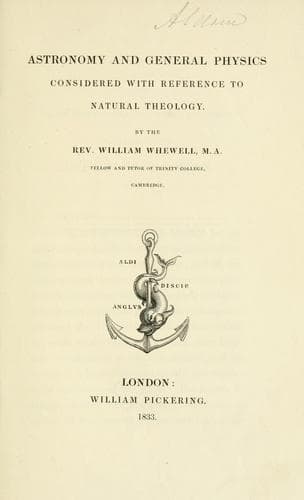
Astronomy and General Physics Considered with Reference to Natural TheologyWhewell, William
Religion
Astronomy and General Physics Considered with Reference to Natural Theology
Whewell, William
Astronomy; Cosmic physics; Natural theology
By the laws of conduction, the daily impressions of heat which the
earth receives, follow each other into the interior of the mass,
like the waves which start from the edge of a canal;[6] and like
them, become more and more faint as they proceed, till they melt
into the general level of the internal temperature. The heat thus
transmitted is accumulated in the interior of the earth, as in a
reservoir, and flows from one part to another of this reservoir.
The parts of the earth near the equator are more heated by the
sun than other parts, and on this account there is a perpetual
internal conduction of heat from the equatorial to other parts
of the sphere. And as all parts of the surface throw off heat by
radiation, in the polar regions, where the surface receives little
in return from the sun, a constant waste is produced. There is
thus from the polar parts a perpetual dispersion of heat in the
surrounding space, which is supplied by a perpetual internal flow
from the equator towards each pole.
Here, then, is a kind of circulation of heat; and the quantity and
rapidity of this circulation, determine the quantity of heat in the
solid part of the earth, and in each portion of it; and through
this, the _mean_ temperature belonging to each point on its surface.
If the earth _conducted_ heat more rapidly than it does, the
inequalities of temperature would be more quickly balanced,
and the temperature of the ground (below the reach of annual
and diurnal variations) would differ less than it does. If the
surface _radiated_ more rapidly than it does, the flow of heat
from the polar regions would increase, and the temperature of the
interior of the globe would find a lower level; the differences of
temperature in different latitudes would increase, but the mean
temperature of the globe would diminish.
There is nothing which, so far as we can perceive, determines
necessarily, either the conducting or the radiating power of
the earth to its present value. The measures of such powers, in
different substances, differ very widely. If the earth were a globe
of pure iron, it would conduct heat, probably, twenty times as
well as it does; if its surface were polished iron, it would only
radiate one-sixth as much as it does. Changes in the amount of the
conduction and radiation far less than these, would, probably,
subvert the whole _thermal_ constitution of the earth, and make it
uninhabitable by any of its present vegetable, or animal tenants.
Public-domain text, read in full here on John Shaqi.
Reviews
Reviews
No reviews yet
Be the first to share your thoughts on this work.
Join the Discussion
Join the discussion
Sign in to leave a comment or review.
Sign InorCreate an account