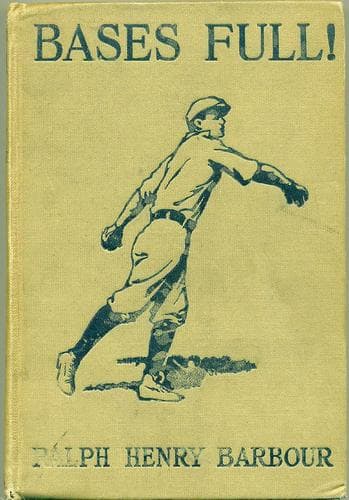
Baseball stories; Boarding schools -- Juvenile fiction; School sports -- Juvenile fiction; Teenage boys -- Juvenile fiction
Loring was getting a great deal of enjoyment out of life those days.
That discussion with Coach Connover had led to others. Steve, although
he was perhaps never swayed by Loring’s views, seemed to find the
boy’s theories and judgments interesting. It was at his suggestion
that Loring’s chair was rolled to the end of the players’ bench of an
afternoon, and frequently the coach slipped into the seat beside him
and conversed. He was genuinely surprised when Loring confessed to
having witnessed but four baseball games previous to this spring and
to having obtained what knowledge of the game he possessed from the
perusal of every book on the subject that he had been able to lay hands
on and from watching the practice. In defense Loring said one day:
“Of course, Mr. Connover, I understand that I don’t really know much
about the game. A fellow can’t, I guess, unless he plays it. All I’ve
got is a lot of theoretical stuff. It――it’s mighty good of you not to
laugh at me, sir.”
“Laugh at you? Nonsense, Deane. What you call theoretical stuff is
perfectly sound, and I find it remarkable that you have absorbed so
much of it without――how shall I put it?――without more incentive. Here
you are, physically barred from playing, with a full knowledge of
baseball, and all around us are fellows actually engaged in playing
who don’t know the rules of the game, to say nothing of the strategy.
No, you don’t owe any one an apology for being able to talk baseball
intelligently, Deane, and if I don’t always agree with you it isn’t
because your theories are wrong but because no theory――no baseball
theory, at least――is always applicable in practice. A certain situation
may call for one procedure to-day and a different procedure to-morrow,
and that is largely because theories do not take into consideration
the personal equation. I am not, of course, speaking now of the few
hard and fast――er――tenets of the game; laws firmly established by
experience; but of the more hypothetical theories that we call ‘inside
stuff.’ Given a certain situation, Deane, the coach or the captain
has to measure the book theory against all sorts of conditions; the
opposing team’s reactions to certain moves, the abilities of his own
players to perform those moves, many things. A play that might succeed
in the early innings would fail in the later for any one of a number
of reasons. Even weather is a factor, and as for psychology――” Steve
sighed――“once a coach starts on psychology he’s lost!”
“I’m afraid I don’t understand that,” said Loring.
Public-domain text, read in full here on John Shaqi.
Reviews
Reviews
No reviews yet
Be the first to share your thoughts on this work.
Elsewhere in the archive
Join the Discussion
Join the discussion
Sign in to leave a comment or review.
Sign InorCreate an account