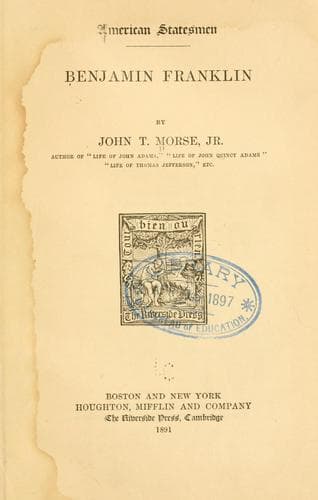
Benjamin FranklinMorse, John T., Jr. (John Torrey)
History
Benjamin Franklin
Morse, John T., Jr. (John Torrey)
Franklin, Benjamin, 1706-1790
The gap between him and them did indeed seem a wide one. In the colonies
there was universal wrath, oftentimes swelling into fury; in some places
mobs, much sacking of houses, hangings and burnings in effigy;
compulsion put upon king's officers publicly to resign their offices;
wild threats and violence; obstruction to the distribution of the
stamped paper; open menaces of forcible resistance, even of secession
and rebellion; a careful estimating of the available armed forces among
the colonies; the proposal for a congress of colonies to promote
community of action, to protest, and to consult for the common cause;
disobedient resolutions by legislatures; a spreading of the spirit of
colonial union by the general cry of "Join or die;" agreements not to
import or use articles of English manufacture, with other sunderings of
commercial relations. Far behind this mad procession, of which the more
moderate divisions were marshaled by Otis, Sam Adams, and Gadsden, and
soon also by John Adams and Patrick Henry, and by many other well-known
"patriots," Franklin appeared to be a laggard in the rear distance, with
disregarded arguments and protests, with words of moderation, even
counsels of submission, nay, actually with a sort of connivance in the
measure by the nomination of an official under it.
Yet the intervening space was not so great as it appeared. There was
nothing in the counsels of the reasonable and intelligent "patriots"
which was repugnant to Franklin's opinions. So soon as he saw the ground
upon which they had placed themselves, he made haste to come into
position with them. It was fortunate indeed that the transient
separation was closed again before it could lead to the calamity of his
removal from his office. For no man or even combination of men, whom it
was possible to send from the provinces, could have done them the
services which Franklin was about to render. Besides the general power
of his mind, he had peculiar fitnesses. He was widely known and very
highly esteemed in England, where he moved in many circles. Among
members of the nobility, among men high in office, among members of
Parliament, among scientific men and literary men, among men of business
and affairs, and among men who made a business of society, he was always
welcome. In that city in which dinners constituted so important an
element in life, even for the most serious purposes, he was the greatest
of diners-out; while at the coffee-houses, clubs, and in the
old-fashioned tavern circles no companion was more highly esteemed than
he. He consorted not only with friends of the colonies, but was, and for
a long time continued to be, on intimate terms of courteous intercourse
also with those who were soon to be described as their enemies. Each and
all, amid this various and extensive acquaintance, listened to him with
a respect no tithe of which could have been commanded by any other
American then living. The force of his intelligence, the scope of his
Public-domain text, read in full here on John Shaqi.
Reviews
Reviews
No reviews yet
Be the first to share your thoughts on this work.
Join the Discussion
Join the discussion
Sign in to leave a comment or review.
Sign InorCreate an account