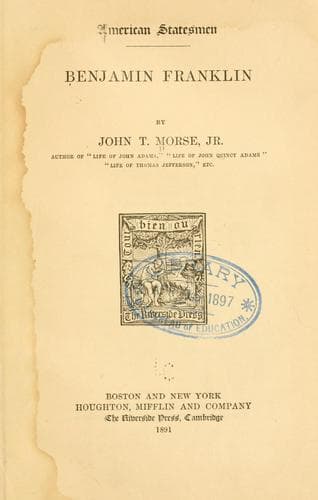
Benjamin FranklinMorse, John T., Jr. (John Torrey)
History
Benjamin Franklin
Morse, John T., Jr. (John Torrey)
Franklin, Benjamin, 1706-1790
The immediate forerunner in Parliament of the repeal of the Stamp Act
was significant. A resolution was introduced into the House of Lords,
February 3, 1766, that the "king in Parliament has full power to bind
the colonies and people of America in all cases whatsoever." The debate
which followed showed what importance this American question had assumed
in England; the expression of feeling was intense, the display of
ability very great. Lord Camden and Lord Mansfield encountered each
other; but the former, with the best of the argument, had much the worst
of the division. One hundred and twenty-five peers voted for the
resolution, only five against it. In the Commons, Pitt assailed the
resolution, with no better success than had attended Camden. No one
knew how many voted Nay, but it was "less than ten voices, some said
five or four, some said but three."[20] Immediately after this assertion
of a principle, the same Parliament prepared to set aside the only
application of it which had ever been attempted. It was well understood
that the repeal of the Stamp Act was close at hand.
[Note 20: Bancroft, _Hist. U. S._ v. 417.]
It was at this juncture that Franklin, who had been by no means idle
during the long struggle, appeared as a witness in that examination
which perhaps displayed his ability to better advantage than any other
single act in his life. It was between February 3 and 13, 1766, that he
and others were summoned to give testimony concerning the colonies at
the bar of the House of Commons sitting in committee of the whole. The
others have been forgotten, but his evidence never will be. The
proceeding was striking; there were some of the cleverest and most
experienced men in England to question him; no one of them singly was
his match; but there were many of them, and they conducted an
examination and a cross-examination both in one; that is to say, those
who wished to turn a point against him might at any moment interpose
with any question which might suddenly confuse or mislead him. But no
man was ever better fitted than Franklin to play the part of a witness,
and no record in politics or in law can compare with the report of his
testimony. Some persons have endeavored to account for, which means of
course to detract from, its extraordinary merit by saying that some of
the questions and replies had been prearranged; but it does not appear
that such prearrangement went further than that certain friendly
interrogators had discussed the topics with him so as to be familiar
with his views. Every lawyer does this with his witnesses. Nor can it be
supposed that the admirable replies which he made to the enemies of
America were otherwise than strictly impromptu. He had thorough
knowledge of the subject; he was in perfect control of his head and his
temper; his extraordinary faculty for clear and pithy statement never
showed to better advantage; he was, as always, moderate and reasonable;
Public-domain text, read in full here on John Shaqi.
Reviews
Reviews
No reviews yet
Be the first to share your thoughts on this work.
Join the Discussion
Join the discussion
Sign in to leave a comment or review.
Sign InorCreate an account